

Making Oat Milk the Default Option Can Cut Coffee’s Carbon Footprint By A Third


People are three times more likely to choose oat milk in their coffee drinks when it is offered as the default option, lowering emissions by 25-34%.
Changing a café’s default milk option from dairy to oat can increase the latter’s adoption and reduce the emissions of coffee beverages, a new study has found.
Researchers in the UK tested whether “default nudges” could encourage greater consumption of plant-based milk in a university coffee shop by automatically giving customers oat milk unless they specifically requested dairy or another type of milk.
“We found that customers were approximately three times more likely to consume plant-based milk when oat milk was the default milk option instead of dairy milk, and that the milk-based carbon footprint per drink reduced by 25%–34%,” said Katie Major-Smith, a PhD candidate at Plymouth Marjon University and lead author of the study.
Offering oat milk by default can triple adoption in cafés
The experiment was carried out at Plymouth Marjon University’s main coffee shop, Barjon Café. Oat milk was chosen as it was the most requested non-dairy option among its customers and has a low environmental impact.
The changes were highlighted in three signs at the till and a wall outside the café, which also informed customers that they could request other milk options when ordering.
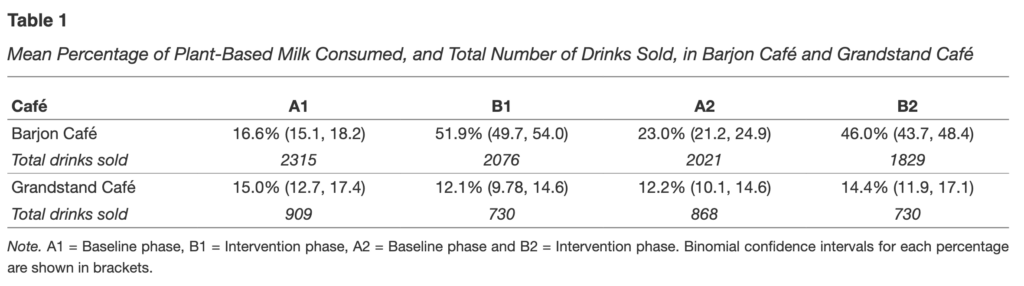
When dairy was the default option, only 17% of drinks were modified to use oat milk instead. But during the intervention, when oat milk was the standard, this tripled to 51%.
The researchers then reverted to dairy as a default option, a period in which oat milk adoption increased to 23% of drinks. But when they switched back to oat as the default for a second time, the effect of the nudge decreased slightly, though still doubled to 46% of orders.
“Comparable data in the university’s second café (where the default nudge was not implemented) found no differences in plant-based milk intake during the study period, suggesting that changes in plant-based milk consumption were due to the default nudge,” said Major-Smith.
Since dairy has a much larger climate footprint than oat milk – it emits over three times more greenhouse gases, takes up 11 times more land, and uses 13 times more water – the increase in the latter’s adoption significantly lowered the drinks’ environmental impact during the intervention.
In the first phase, there was a 30-34% decrease in milk-related emissions, while the second phase saw emissions slashed by 25-28%.
“Plus, informally, there were no complaints about oat milk being the default milk type; in fact, customers gave positive feedback on the change,” Major-Smith revealed.
Default nudges among the most effective levers to drive plant-based consumption

The research, published in Global Environmental Psychology, is the latest example of the efficacy of default nudges. Several behavioural science studies and trials over the years have found that making plant-based options the default choice can increase their consumption and cut food-related emissions.
In 2022, catering giant Sodexo’s subsidiary, the Good Eating Company, and behavioural choice agency Greener By Default held a successful corporate pilot at LinkedIn’s San Francisco office. In the 12-week pilot, two-thirds of the menu was turned plant-based, and oat milk was made the default coffee bar choice. The intervention halved the emissions of the office, saving 14,400kg of CO2e.
The same year, New York City launched a ‘plant-based by default’ scheme in its 11 public hospitals, making vegan meals the preexisting choice for patients and their families. Half of all patients have chosen to eat meat-free dishes because of the initiative, with 90% satisfied with the food. As a bonus, it helped hospitals cut their emissions and costs too.
Meanwhile, Sodexo partnered with behavioural science non-profit Food for Climate League and dietary change think tank the Better Food Foundation to run a trial across three university and college campuses. The research showed that serving plant-based food by default could drive 82% more students to choose vegan meals, in turn reducing emissions by nearly 24%.
And in a review of 93 behavioural change techniques last year, experts outlined that offering vegan dishes by default was among the best ways to get people to eat less meat in public settings.
“Default nudges can help encourage plant-based diets among consumers by reducing dairy consumption and enhancing sustainable plant-based milk,” Major-Smith and her colleagues wrote. They’re also likely to benefit organisations whose sustainability strategies are built on targets linked to reducing their climate footprint and ramping up their sustainable procurement.