

No Confusion: Nearly All Brits Know Plant-Based Products Don’t Contain Meat


As EU policymakers mull further restrictions on plant-based meat labels, which could affect the UK too, a new survey shows that 95% of Brits recognise that a meat-free product is, in fact, meat-free.
Adding to a well-established body of evidence reinforcing consumer understanding of food labels, new research from the UK shows that nearly all respondents understand that plant-based meat contains no animal products.
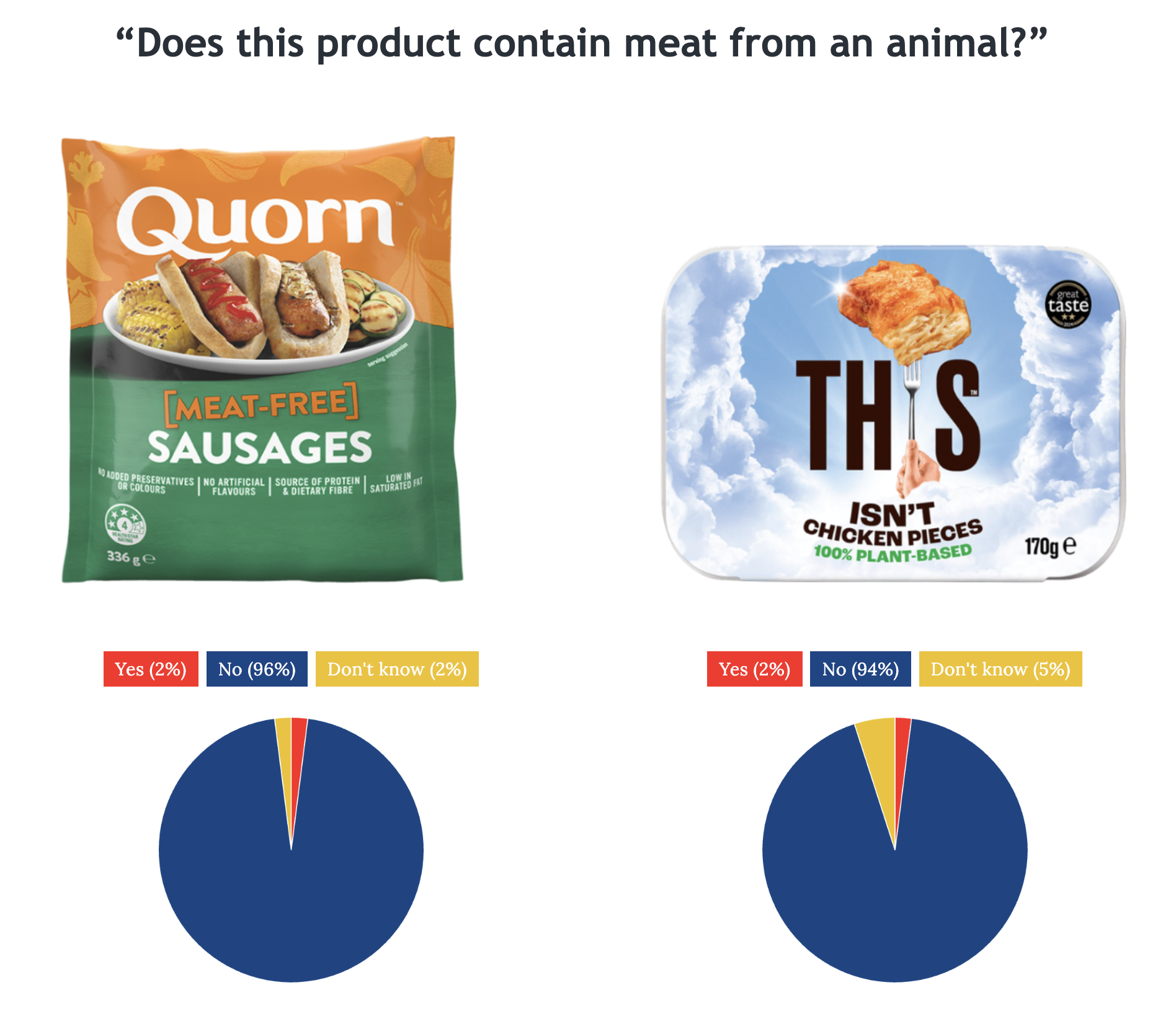
The survey, conducted by Bryant Research, asked over 1,000 Brits if the packaging of existing meat alternatives confused them and made them mistake the products for conventional meat, targeting the justification offered by policymakers and the livestock industry when calling for a ban on meat-related terms on plant-based products.
The respondents were shown images of two popular meat-free products in the UK. When it came to Quorn’s mycoprotein sausages, 96% correctly said they don’t contain meat, with only 2% thinking they do. Likewise, 94% said This’s vegan chicken is free from meat, and only 2% believed it does.
“This is strong evidence against the claim that consumers are confused by [plant-based] products using the words ‘sausage’ and ‘chicken’ in their names,” said Chris Bryant, founder and director of Bryant Research.
Plant-based meat labelling ban could be widened
The finding is highly relevant given that meaty words on plant-based product labels are on the ouster. In February, policymakers in the EU voted in favour of an amendment to the Common Market Organisation (CMO) regulation, which urged the bloc to ban companies from using terms like ‘steak’ and ‘sausages’ on meat-free packaging.
The legislation, which has come to be colloquially known as the “veggie burger ban”, was brought by French lawmaker and European People’s Party (EPP) member Céline Imart, a cereal farmer with close links to the French farming lobby.
After months of negotiations, the EU decided to outlaw ‘meat’ and 31 other related terms – including ‘beef’, ‘chicken’, ‘pork’ and ‘veal’ – from being used to market vegan and vegetarian alternatives, as well as cultivated meat (which isn’t on the EU human foods market yet). Terms like ‘burger’, ‘sausage’, ‘nuggets’, and ‘ham’, however, were spared.
The amendment was published in the EU’s official journal in mid-August, officially giving manufacturers three years to begin complying. Days later, members from the EPP, Patriots for Europe and the European Conservatives and Reformists Group signed another set of amendments to the CMO, seeking to extend the ban to a broader set of words.
This would outlaw terms such as ‘meatballs’, ‘rabbit’, ‘black and white blood sausage’ and ‘Adenauer Sausage’ (a plant-based alternative born out of World War I shortages). And the ban takes aim not just at plant-based and cell-cultured meat, but also the emerging blended meat category.
The effort has already faced widespread criticism from politicians, food manufacturers, and trade associations. The Progressive Alliance of Socialists and Democrats, Greens-European Free Alliance, and The Left have proposed either deleting the blacklist entirely, or easing its implementation on a technical level.
Still, the European Parliament’s agriculture committee will hold technical meetings on the proposal, with a vote scheduled for December. The final plenary vote will take place in 2027.
EU ban could extend to UK, despite consumer clarity
While the brouhaha over what to call vegan bacon has been bubbling within the EU, it could affect the UK, too, thanks to the newly signed Sanitary and Phytosanitary (SPS) agreement.
Set to take effect in mid-2027, the SPS deal ned to make the transfer of goods, including food products, between the EU and the UK easier and cheaper, but it could tie the latter to some of the bloc’s food labelling laws.
The ban’s proponents say meat-like terms on meat-free products mislead consumers, who could mistakenly buy a plant-based alternative thinking it’s meat. The Bryant Research survey dispels that theory, as do nearly all studies on this subject in recent years, outlining that people aren’t as unintelligent as the EU’s lawmakers would have you believe.
In a large poll by the European Consumer Organisation in 2020, 80% of people said plant-based meat should be allowed to use such terms. In the 2023 Smart Protein survey, only 9% of citizens from nine member states said they didn’t recognise plant-based meat alternatives.
More recently, in a 20,000-person poll, 96% of Dutch consumers said a veggie sausage is, well, a veggie sausage. Nearly 70% opposed a labelling ban, and 63% didn’t think it was important to create regulations on this matter.
Back in the UK, YouGov research in late 2025 showed that 92% of Brits say they’ve never bought, or cannot recall buying, a plant-based sausage or burger thinking it contained meat. And this year, a survey in Italy revealed that 90% of consumers who buy vegan products know what they’re putting on the plate.
The NoConfusion Coalition, which represents over 600 companies, retailers, investors, consumer and environmental organisations across 22 EU countries, has been leading the charge against the ban with an open letter calling for an end to the effort. Further, it has a citizens’ petition with over 70,000 signatures.