

60% of Germans Back Tax Cut on Plant-Based Milk to Match Dairy VAT


A majority of people in Germany are in favour of a lower VAT rate on plant-based milk, which is bought by nearly half of the country’s consumers now.
People in Europe’s largest plant-based market want its government to level the playing field for non-dairy milks, which are gaining popularity on the back of their health benefits.
Polling by dairy giant Danone and market research firm Innofact finds that 61% of Germans are in favour of a reduced tax rate on plant-based milk, with a sixth (17%) of non-users seeing this as a concrete purchase incentive.
Currently, dairy-free milk carries a 19% VAT rate in the country, nearly triple the 7% levy laid on cow’s milk. Stakeholders like Rewe Group, Oatly, Vly and Berief Food have been petitioning the government to lower the plant-based tax in line with the dairy rate, which would significantly reduce the price consumers pay for milk alternatives.
The Danone survey, which included over 1,500 respondents, reveals that only a third (34%) of the German public knows that cow’s milk carries such a low surcharge. Price is among the top factors keeping them from buying plant-based milk (cited by 44%), second only to taste (54%).
Germans would pay more for fortified plant-based milk
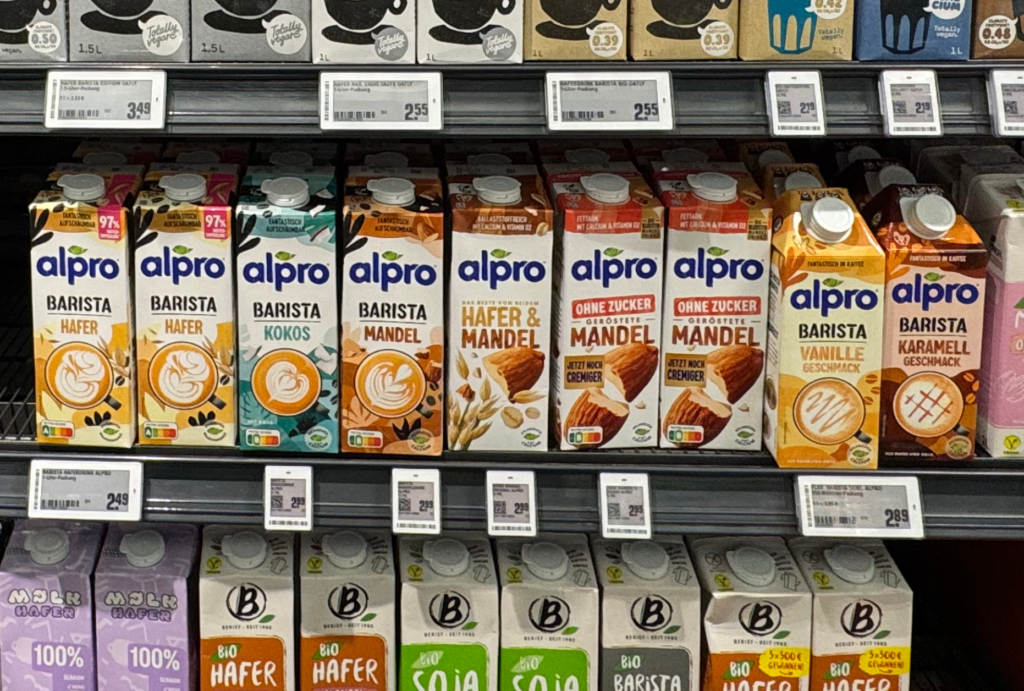
Plant-based milk is the second-largest segment in Germany’s vegan market, racking up nearly €600M in sales in 2024 (a 3.6% hike from the year before). And its popularity is only growing: nearly half of consumers (47%) now drink these products, with 18% doing so regularly.
At the same time, dairy is suffering from historic consumption lows in the country. In 2024, Germans drank just 46.2kg of milk per capita, less than any year on record, and a 15.5% decline from a decade ago.
A key lever of this shift is the decline in the price of plant-based milk. Research by ProVeg International reveals that the cheapest non-dairy alternatives are more affordable than cow’s milk across eight major supermarket chains in Germany, offering an average price advantage of nine cents.
However, these plant-based milks aren’t all fortified with essential micronutrients or suited to coffee drinks, making them less nutritionally and functionally complete than dairy. Fortified or barista-style plant-based milks are usually much more expensive.
With an equitable VAT rate, private-label non-dairy milks will become significantly cheaper than cow’s milk, and the rest will likely reach parity.
This battle isn’t new. In 2023, MPs Tim Klüssendorf (SPD) and Bruno Hönel (Green Party) proposed a change in the country’s tax laws to reduce the VAT on milk alternatives in the annual tax law negotiations, though that effort was unsuccessful. Still, like this new Danone poll, a survey at the time found that 62% of people supported the move.
Danone’s research further reveals that 44% of Germans prefer plant-based milks fortified with vitamins and minerals, and of these respondents, 75% would be willing to pay more for these products. Around 30% would accept a price premium of 10%, with women even open to an increase of up to 20%.
Non-dairy milks most popular among younger consumers

Plant-based milk is particularly popular among those aged 18-29 and households with children, 56% of whom consume these products. These are key target demographics for Danone’s plant-based brand, Alpro, whose 2023 packaging refresh drove up its market share and penetration among Gen Z and Gen Alpha.
“They speak plant-based faster than they speak their mother tongue,” Guillaume Millet, the European VP of plant-based food for Danone, told Green Queen in September.
Alpro is looking to fill the gap in the non-dairy market for kids, who Millet said were short of options outside cow’s milk. “The new generation, they want to have options, and we want to make sure that those consumers are used to the taste of plant-based and can really switch between plant-based and dairy proteins,” he explained.
Danone’s poll reveals that oat milk is the most popular dairy alternative, consumed frequently by 48% of respondents, followed by almond milk (34%). Overall, 95% of Germans drink non-dairy milk at least once per quarter.
Health is the top reason people consume plant-based milk (49%), followed by animal welfare (46%). However, in terms of actually buying these products, the most important drivers are taste (84%), consistency (74%), and value for money (72%).
For the health-conscious, the focus is primarily on healthier fats, organic quality, and added vitamins. Nutrients of particular interest are calcium (55%), vitamin D (50%), and vitamin B12 (49%). And among flexitarians, plant-based proteins, fibre, and iron are important too. Moreover, a quarter of non-users would prefer plant-based milk if it had a comparable nutritional profile to cow’s milk.
“Consumers want products that are not only plant-based but also nutrient-rich. This encourages us to communicate the benefits of added vitamins and minerals even more clearly – and to place greater emphasis on trace elements such as iodine,” Danone said in a statement.
“Our mission is to make healthy nutrition accessible to everyone. The results clearly show that plant-based milk alternatives are no longer niche products and have established themselves as an integral part of a balanced diet.”