

Plant-Based Proteins Have A Taste Problem – This New Startup Has A Fix


Swiss startup SentiaNova has emerged from stealth with a pre-processing technology that removes off-flavours from plant proteins in a bid to tackle one of the industry’s most common complaints.
Addressing the taste barrier that plagues the plant-based food space, Zurich-based SentiaNova has emerged from stealth with a transformative technology for pulses.
The startup’s patented technology removes off-flavours from plant proteins before the processing stage, forming a neutral-tasting base that can enable clean-label formulations and reduce overall costs by 15%.
Its first product is a pea protein concentrate, currently available in sample volumes and ramping up to commercial scale by the end of the year. It will then launch a pea protein isolate as well.
“The conditions for plant proteins to close the protein gap are finally in place. Processing capacity is built, legume cultivation is being incentivised across Europe for local protein sovereignty and nitrogen capture, and demand is accelerating. Taste has been the last barrier,” said SentiaNova co-founder and CEO Daria Reisch.
“SentiaNova removes it, and the independent validation we are publishing today shows we are not incrementally better. We are in a different category,” she added.
An answer to the protein shortage and taste dissatisfaction

Protein is at the top of people’s food priorities today, thanks to a combination of updated dietary guidelines, ever-expanding GLP-1 use, and continued population growth and the livestock industry cannot scale fast enough to meet this demand.
Estimates indicate a need for 3 billion kg of additional whey protein by the end of this year, but this ingredient is already facing shortages. Contracts in the US have been sold well into 2026, pushing manufacturers to look towards Europe. However, this region itself has limited supplies (relative to the global demand), with prices set to hike.
Plant proteins, however, can fill this gap, with roughly half of Europe’s dry fractionation capacity for food-grade pulse protein concentrates currently stranded. The problem, as SentiaNova points out, is their flavour.
Research has consistently shown that the flavour of plant proteins remains the top barrier hindering increased adoption. A taste test of omnivores last year revealed that only 30% of Americans like the average meat-free product, compared to 68% who have a positive opinion of conventional meat.
In fact, meat alternatives were found to have a weird aftertaste or off-flavour five to six times more often than animal proteins. Mushiness and off-colours were some of the other major weaknesses identified in the former group.
This isn’t restricted to the US. A 2023 European survey found that taste was the top factor consumers considered before buying a plant-based product, as cited by 54%.
And manufacturers recognise this. Analysis by the Fairr Initiative suggests that among the world’s largest food companies – think Nestlé, Walmart and Kraft Heinz – 90% continue to launch and promote new plant-based products, but 77% believe concerns over taste, cost and nutrition are hindering consumer uptake.
SentiaNova tackles this by removing bitter, beany and green off-notes, rather than masking them, before the concentration or isolation step. That results in a clean, neutral ingredient base, and works across pulses such as peas, fava beans, mung beans and chickpeas.
Its tech also enhances colour and functional properties such as dispersibility, water retention, and emulsification, which it says unlocks premium food applications at higher inclusion rates without additives. Plus, the platform can be integrated into existing pulse protein manufacturing systems.
SentiaNova’s pea protein impresses sensory panellists
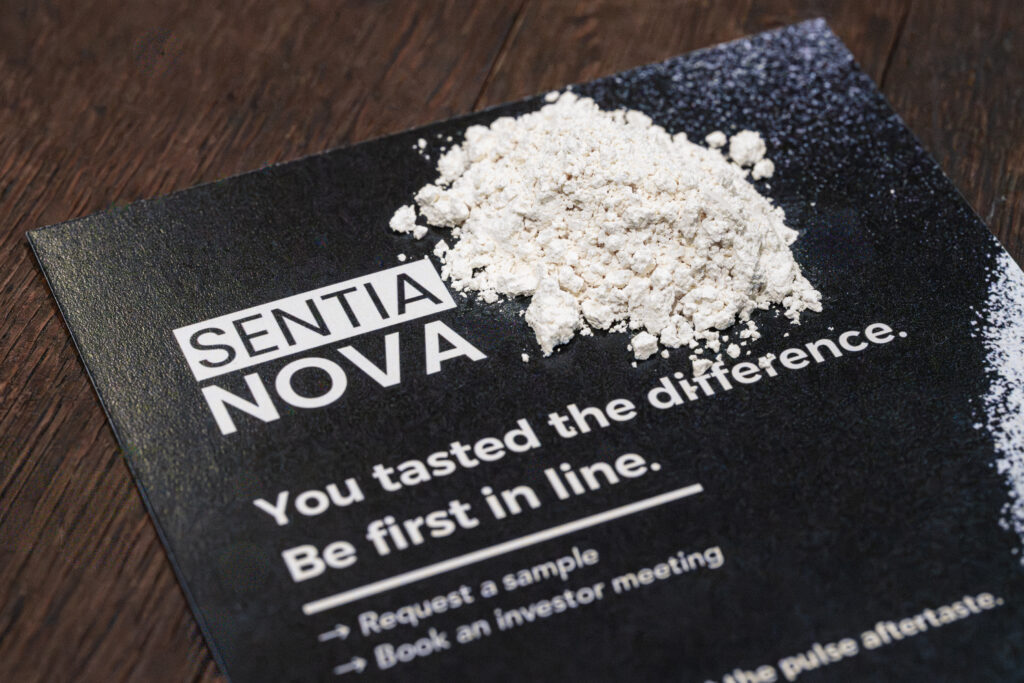
To prove its efficacy, SentiaNova commissioned an independent sensory evaluation of its pea protein concentrate, which was found to outperform other de-flavoured pea protein benchmarks on the market, including the leading concentrate and the top-end isolate.
A panel of 12 trained sensory evaluators indicated that SentiaNova’s was the only ingredient to achieve a statistically significant effect in overall off-notes at 99% confidence. The panel further recorded consistent and significant reductions in bitterness, astringency, and green notes.
The evaluation then quantified the downstream impact on formulation economics, replacing the current most neutral concentrate on the market with SentiaNova’s ingredient in a vanilla pudding, which lowered the cost by 15%. This saving is driven by the complete elimination of masking agents and a reduction in vanilla flavouring from 1% to 0.8%.
The startup publicly launched its ingredient at the HackSummit in Lausanne last week (April 22-23), hosting a tasting event where attendees evaluated three finished products built around the pea protein concentrate: a vanilla pudding, a ready-to-drink protein beverage, and a protein ball. These innovations showcased the innovation’s white colour, high dispersibility, and functional performance.
SentiaNova also operates an opex- and capex-light production model by partnering with established pulse protein manufacturers to bring high volumes to market in short timeframes. The ingredient does not require any regulatory approval in major markets, and allows companies to plan reformulations and new products against a “near-term commercial horizon”.
“I have spent 26 years building plant protein facilities, and I have watched a lot of interesting technologies fail because the unit economics did not work,” said co-founder and CTO Roi Wurgaft.
“That is why we built SentiaNova the way we did. Clean taste at an affordable price is what the industry has been asking for. Everything else is secondary,” he added.