

Jellatech Partners with South Korea’s Hugel to Bring Cell-Cultured Human Collagen to Market


US biotech startup Jellatech has signed a deal with South Korea’s Hugel to develop and commercialise its cell-based human collagen for medical aesthetics and cosmetic products.
Jellatech is inching closer to bringing its recombinant human collagen to market, having partnered with Seoul-based medical aesthetics company Hugel to advance its cell culture platform’s development and commercialisation.
The two companies have signed a strategic collaboration focused on next-generation human collagen injectables and cosmetic products, giving Hugel exclusive global rights to Jellatech’s collagen for select aesthetic applications.
The deal includes a collaborative development framework designed to accelerate innovation in medical aesthetics, with an initial focus on advancing novel skin-boosting and aesthetic applications, while also creating opportunities for future use across regenerative medicine and therapeutics.
It marks Jellatech’s first major commercial milestone. “We are excited to continue building, scaling, and expanding our platform into broader applications and markets, and we look forward to bringing in additional capital and new strategic investors to support that growth,” said CEO Stephanie Michelsen.
Jellatech focused on type I human collagen
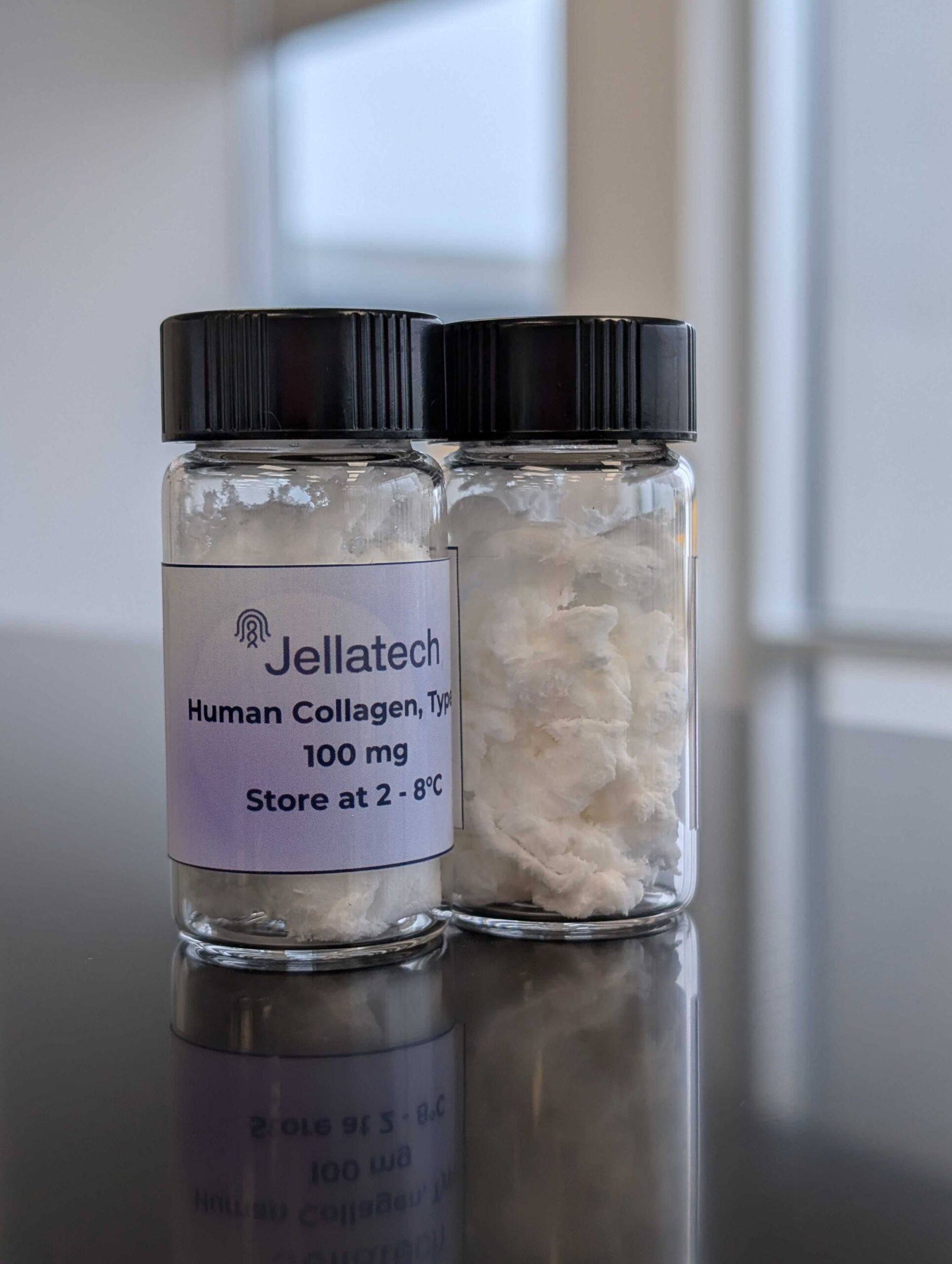
Previously focused on recombinant bovine and porcine collagen, Jellatech unveiled its bioidentical human collagen in 2023, after developing a proprietary technology to produce and purify the compound from human cells cultured in bioreactors.
It leverages a one-time 3mm skin biopsy sample to initiate its cell lines, sorting cells to identify those with the highest growth and yield potential. After three weeks, the collagen is harvested from the cells and purified to greater than 95% purity using proprietary techniques.
This process enables the scalable manufacturing of collagen that produces the structure and functionality of native human collagen without relying on animal sources, peptides, or non-native recombinant production methods.
Jellatech’s current portfolio houses two human collagen products. Type I atelocollagen is a highly purified, full-length, triple-helical collagen that is bioidentical to the one derived from human tissues. With telopeptide regions removed, it offers superior biocompatibility and reduced immunogenicity, and its purified form supports consistent cell attachment, fibrillar gelation, and controlled matrix remodelling.
The other innovation is a type I telocollagen, in which telopeptide regions are intact. This offers exceptional biomimicry and mechanical integrity, enables superior fibrillogenesis and tissue integration, and promotes natural cell adhesion and long-term structural support.
Together, the two collagen products offer complementary advantages for therapeutic and aesthetic applications, tailored to immunogenicity, mechanical requirements, and tissue interactions.
“This partnership represents a major inflexion point for Jellatech and a meaningful validation of our technology platform,” Michelsen said, referring to the Hugel deal.
“Hugel’s global leadership in aesthetics, combined with our human collagen platform, creates an exciting opportunity to develop truly next-generation products for patients worldwide.”
Cell culture tech can help overcome collagen industry bottlenecks
Typically found in cattle, pigs and fish, collagen is the most abundant protein in animals. However, it has a detrimental impact on the planet. Tens of thousands of cattle raised for collagen production are on farms linked to deforestation in the Amazon, an ongoing crisis contributing to climate change and biodiversity loss.
The benefits of collagen are subject to major debate. Though some claim it can improve hair, skin, nails and joints, the Harvard School of Public Health cautions consumers over study findings as most, “if not all”, of the research has been funded by industry members or scientists affiliated with stakeholder brands.
That said, some studies point to the benefits of consuming collagen-building foods, rather than consuming collagen itself. Foods rich in vitamin C, zinc, copper, silicon, and the amino acids lysine and proline have been linked to healthy collagen production.
Still, the global collagen market is valued at $12.7B, and is expected to grow annually by 11% until 2033. But conventional collagen products face challenges related to their biological compatibility, scalability, or inability to fully replicate the complex native structure and functionality of human collagen. It’s what makes Jellatech’s technology highly useful.
“Through our partnership with Jellatech, we are gaining access to an innovative, differentiated collagen technology platform that has the potential to deliver truly regenerative solutions that our aesthetics customers and consumers desire,” said Carrie Strom, president and global CEO of Hugel.
Hugel is recognised as a leader in medical aesthetics, with an expansive portfolio of botulinum toxin products, dermal fillers and cosmetics. It is now boosting its next-gen skin-boosting platform through strategic business development initiatives and investments in innovative technologies.
Jellatech, which has raised over $5.5M in funding, isn’t the only one working on novel forms of collagen. France’s Geltor uses precision fermentation to produce a biomimetic human type XXI collagen, while beauty giant L’Oréal has previously launched skincare products with an amino acid sequence 100% homologous to type III collagen found in human skin.
And Singapore’s Avant has unveiled a regenerative peptide complex that instructs skin cells to boost the extracellular matrix and generate more collagen, integrin and fibrinogen.