

‘Lab-Grown’? ‘Cell-Cultured’? New Research Shows the Best Way to Describe Cultivated Meat


Cultivated meat is still referred to by an array of names, from ‘lab-grown’ to ‘cell-cultured’ – a new poll spotlights the most appealing way to describe it to consumers.
In a country with more regulatory approvals and more bans for cultivated meat than any other, how do you best describe these proteins?
That was the thesis of newly published research by the Good Food Institute (GFI), which sought to find out which terms and descriptors resonate most with Americans, and which ones are more polarising.
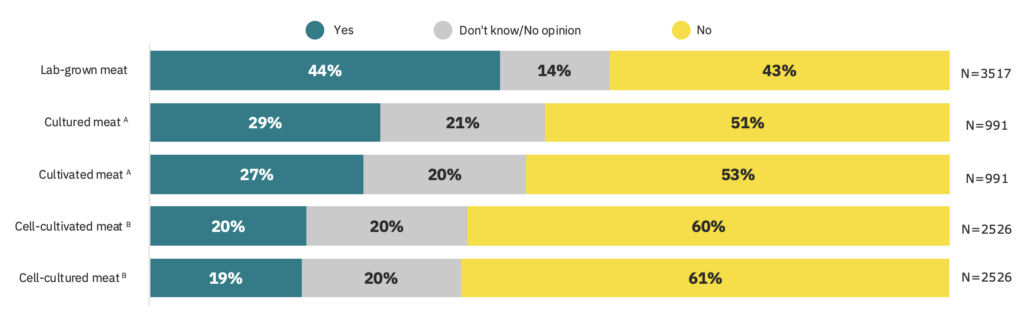
It found that a majority of Americans aren’t aware of this innovation. Of those who are, ‘lab-grown meat’ is the most popular term, familiar to 44% of the 3,500 respondents.
Only 29% have heard ‘cultured meat’ and 27% ‘cultivated meat’ – despite this finding, GFI says it recommends using the latter, citing earlier research that showed this term “maximises differentiation, accuracy/descriptiveness, and appeal”.
Benefits in, processes out
When GFI asked Americans about their attitude towards cultivated meat, it emerged that only 21% find it appealing, and another 22% say they are unsure.
That doesn’t mean they aren’t open to it – 45% of consumers are likely to try these proteins, and one in four (26%) say they might buy them, despite the uncertainty around their appeal.
The reserach reveals that cultivated meat becomes more attractive to consumers when they’re exposed to simple descriptors. After respondents read one of seven tested descriptions, the net appeal shot up by 18 percentage points and purchase intent by 10 points on average. Most of the people who changed their minds were previously undecided.
Consumers responded most positively to descriptors that articulated benefits like the similarity of cultivated meat to conventional animal proteins, its nutritional value and quality, and its benefits to society and the environment.
The descriptors with the highest net appeal were “no sacrifice required” and “100% real meat”, while “future-friendly way to grow food”, “high-quality food”, “same as the meat we eat today”, and “antibiotic-free” appeared close to the top of this list.
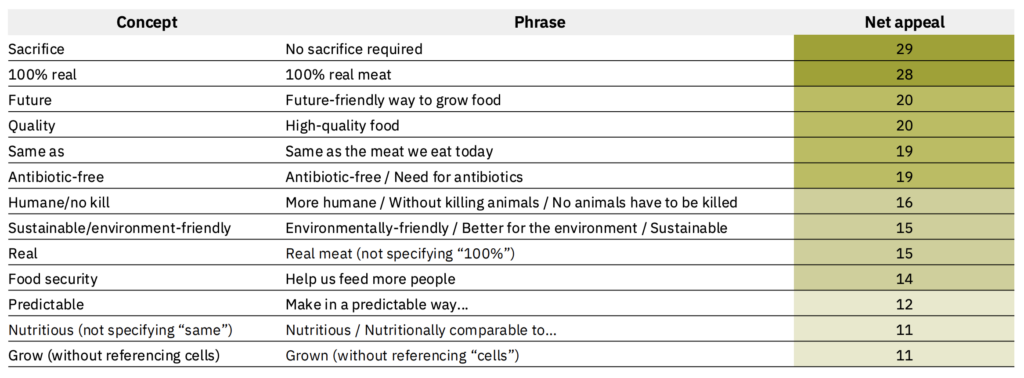
On the flip side, phrases that conveyed the technical aspect of how cultivated meat is produced were the most polarising – think scientific explanations referring to cells, and “visceral-sounding language”. Some of the descriptors with the lowest appeal were “grown from cells”, “grown outside the animal”, and “facility that looks like a beer brewery”.
That said, GFI noted that these phrases have been effective at building understanding. So combining them with more helpful descriptors could still be helpful to create an effective message when deployed strategically.
How can cultivated meat companies attract more consumers?
The results of this latest survey are in contrast with previous polls. In 2022, a peer-reviewed study found ‘lab-grown’ and ‘artificial meat’ to be the least favourable terms among consumers, and ‘cell-cultured’ and ‘cell-cultivated’ the most popular.
A year earlier, in a GFI survey of 44 industry CEOs, 75% preferred ‘cultivated’ too. In Singapore, too, meat-eaters had a more positive attitude towards ‘cultivated meat’ than other terms. This was followed by‘lab-grown’, ‘animal-free’, ‘cultured’ and ‘clean’ – the more literal ‘cell-based’ was the least favoured.
To highlight how companies can start building consumer interest and appeal towards cultivated meat, GFI’s new report recommends anchoring the messaging on meat – highlighting how similar it is to conventional meat is a “compelling and widely relevant” approach.
Further, the authors suggest it’s important to outline the differentiating benefits of these proteins – even though they taste like conventional meat, they do away with antibiotics, slaughter, and harm to the planet. “However, the relevance and priority may differ depending on the brand or use case,” says GFI.

Companies must carefully explain the “how” of it all – current ways to describe the production process can increase understanding but decrease appeal. There are several tactics to counter this – phrases like ‘cultivated’ are less negative than anything referencing ‘cells’, for instance, while pairing polarising descriptors with multiple benefits can still help strike the balance between appeal and comprehension.
Meanwhile, some phrases that cue processes or differentiate from other products – such as “made in a safe, controlled environment” or “not plant-based”, respectively – can aid understanding with minimal negative impact on appeal. GFI also calls for further reserach to explore process descriptors that elicit more neutral or even positive reactions.
Finally, the report notes that the most effective messages may vary by use case, so testing and refining their usage with target customers is crucial.