

Livekindly Collective Steps Up M&A Strategy with Greenforce Takeover

US holding company Livekindly Collective has signed its latest acquisition deal with the purchase of German plant-based foods startup Greenforce.
“This category will keep consolidating, which – given our strong position in the market – always gives us the opportunity to consider acquiring an organisation that could help us disproportionately accelerate growth and profitability,” David Suarez, CEO of Livekindly Collective, told Green Queen last September.
“We are always looking, and if we decide to move, we will do it in a very strategic way,” he added, signalling the company’s M&A-driven growth blueprint.
Months later, the company took over Tindle Foods’s foodservice operations in the US, the UK and Germany. Now, it has signed a deal for its latest acquisition to double down on this strategy.
The owner of Oumph, Like and Fry’s is adding German startup Greenforce to its portfolio of plant-based brands, in an effort to consolidate its position in Europe’s largest market for vegan food.
“We have the operational strength, international infrastructure and market knowledge to take strong local brands to the next level of growth,” Suarez says now. “The integration of Greenforce is another important step in our strategy to lead this category, with a clear focus on growth and sustainable profitability.”
The acquisition is subject to customary regulatory approval, until which time the companies will continue to operate independently.
Leveraging Germany’s leading market for plant-based food
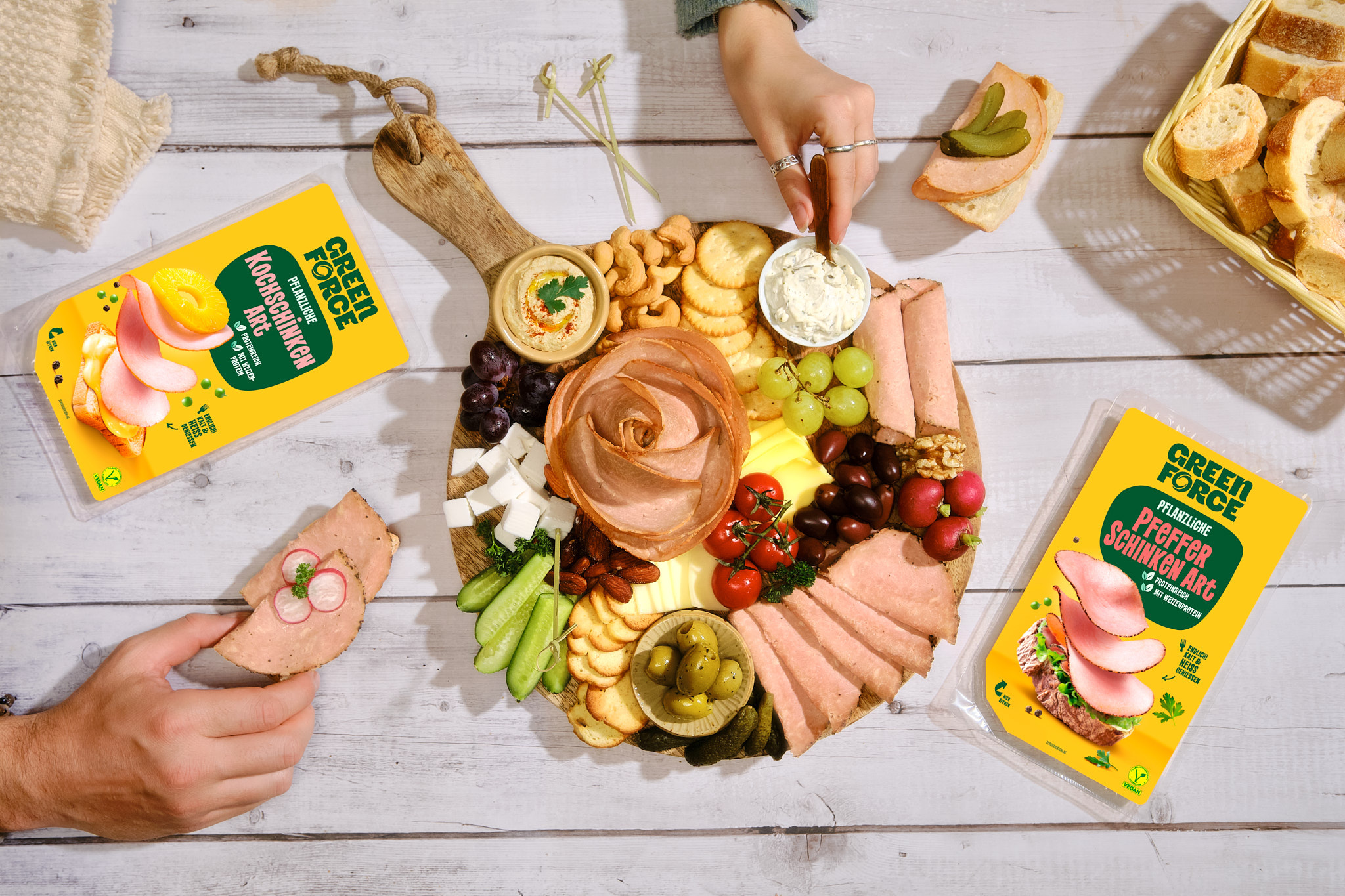
Founded in 2020 by CEO Thomas Isermann, Greenforce sells a wide array of plant-based products, including meat, cheese and egg alternatives.
Its offerings are available online on various marketplaces and across major supermarket chains in Germany and Austria, including Rewe, Edeka, Kaufland, and Spar.
This multi-category approach and established distribution network would no doubt have appealed to Livekindly Collective, whose decision to acquire Greenforce will help expand its portfolio, and boost its innovation ability, depth of value creation, and market penetration.
No European country buys more plant-based alternatives than Germany. In 2025, sales of this category surpassed €1.7B (a 3% year-on-year hike), driven by sustained purchases of meat analogues, and an 8% rise in non-dairy milk sales.
Livekindly Collective’s Like brand is the second-largest in the chilled branded plant-based meat category, according to NIQ RSM. With 12% growth, Like is outpacing others in this market. And in the plant-based strips category, Like holds a market-leading 57% share.
The company’s retail brands are present in more than 40 markets, while its younger foodservice arm ships to 19 countries across five continents, serving more than 40 customers with both private-label and branded products. These are supported by its three pure-play factories in Oss (Netherlands), Stora Levene (Sweden), and Pinetown (South Africa).
Acquisitions central to Livekindly Collective’s growth after becoming profitable
Livekindly Collective says the acquisition is further evidence of its strong consolidation capabilities, from “identifying high-growth brands to strategically integrating and scaling them” across global sales and production structures.
“The market for plant-based foods is entering a phase of strategic consolidation. At Livekindly Collective, we are actively shaping this development,” says Suarez.
Indeed, consolidation seems to be the name of the game in the alternative protein category, where over 80 companies have been acquired, merged, fallen into insolvency, or shut down since September 2024. In the last month alone, NotCo’s Argentinian and Uruguayan business, Bobeldijk Food Group, NovoNutrients, and BettaF!sh were all snapped up by other food industry players.
Livekindly Collective is well-suited to this trend, as it combines international production capacities, strong distribution networks and established brand platforms under one roof. That structure helps it systematically exploit synergies, accelerate innovation cycles, and increase profitability across the entire value chain.
It led the firm to achieve its first month of profitability last September, when it recorded a 15% increase in year-on-year sales, on the back of single-digit year-on-year growth in the first half of 2025. Its B2B business has also witnessed major increases, and the company has projected a further 200% uptick for 2026.
Speaking to Green Queen in November, Suarez laid out Livekindly Collective’s strategy for the upcoming year: “As we enter 2026, the priority is profitable growth. Profitability gives us the confidence and stability to expand where it makes sense, whether that means new markets, channels, or products.”