

Can Protein Grown Inside Potatoes Help You Live Longer?


Reagenics Research produces protein inside potatoes via plant cell culture, and studies show its low methionine content can help build muscle and slow ageing. Could the spud be the key to longevity?
Globally, up to 60% of people say healthy ageing is a top priority for them, fuelling the growing demand for products that support longevity.
Food innovations that can help extend your lifespan are gaining more prominence than ever – it’s why the Blue Zones movement has transformed from a diet inspired by the longest-living populations to a Netflix docuseries and a supermarket product line.
Plant-based foods like vegetables, fruits, nuts and legumes have long been associated with longevity. Building on that philosophy is Reagenics Research, a startup that uses plant cell culture to produce a protein-rich biomass from potatoes.
The company is targeting the longevity space on the back of research that confirms its ‘Poteins’ ingredient stimulates muscle protein synthesis at a comparable level to whey, and has a methionine content well below most proteins.
It explains that older adults need more high-quality protein to counter sarcopenia, a progressive, age-related muscle loss that’s among the strongest predictors of mortality. However, peer-reviewed studies suggest that excess dietary methionine – abundant in animal proteins – can drive the mTOR overactivation and oxidative stress pathways linked to accelerated ageing.
By offering a flavour- and colourless protein that helps maintain muscle with the lowest methionine loading of any anabolically effective protein source available today, Reagenics believes it is primed for the healthy ageing era.
How Reagenics makes its potato protein
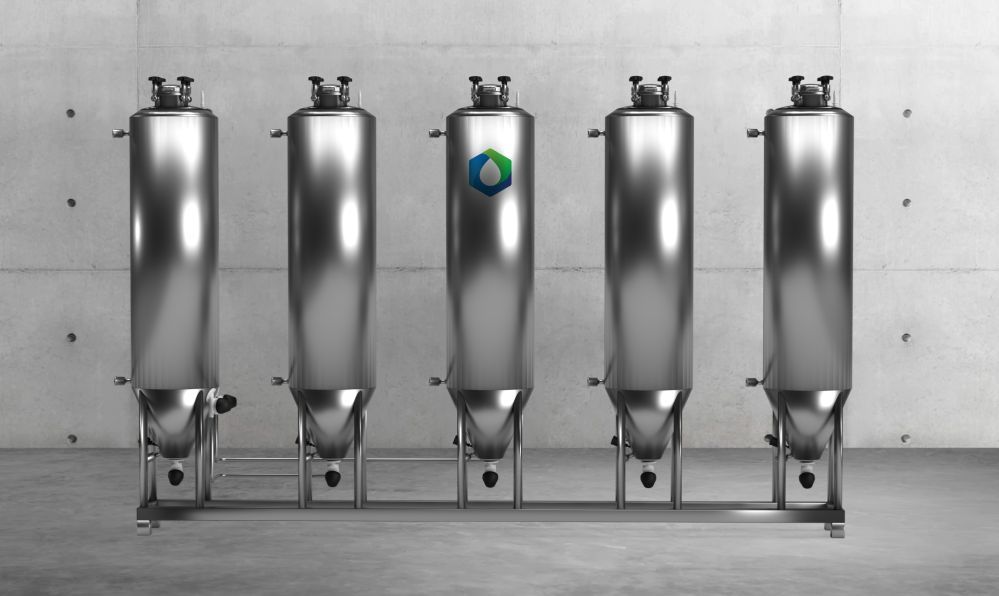
Reagenics is one of several companies leveraging plant cell culture to grow next-generation proteins at scale. This technology involves growing plant cells in bioreactors, eschewing conventional agriculture inputs like water or soil, and ensuring a climate-resilient supply.
“Our process begins with undifferentiated potato plant cells – callus tissue derived from the source plant – which we propagate in controlled liquid bioreactor environments through a process called callus stem cell multiplication,” explains Reagenics founder and CEO Michael Kagan.
Unlike conventional potato farming, where whole plants are grown to produce tubers, the firm’s bioreactors maintain cells in a dedifferentiated, proliferating state. There’s no soil, seasons, pests, or light to navigate.
“The cells divide continuously in a nutrient medium, accumulating biomass that we then harvest [and] dry. This biomass contains over 35% protein, up from the 1.5% present in a regular spud… [and] can then be used directly in formulas or… processed into our protein concentrate. It should be stressed that this process is non-GMO.”
In potato tubers, patatin is the dominant storage protein, accounting for around 35-40% of the total soluble tuber protein. It’s what is found in commercial potato protein isolates, which are produced as a byproduct of the potato starch industry. Reagenics’s biomass contains a similar amount of protein, with an amino acid profile comparable to potato protein concentrates.
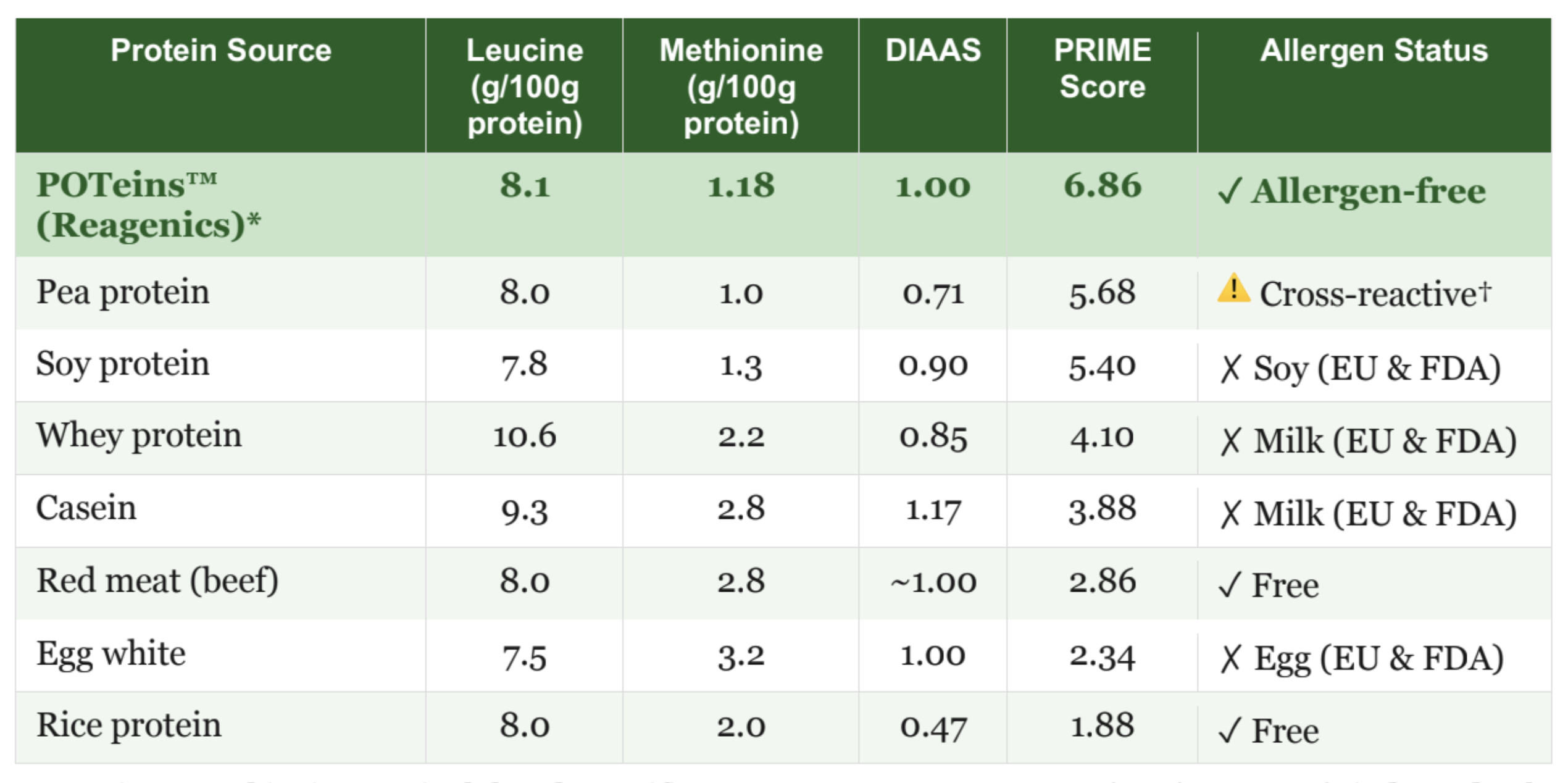
In fact, Poteins contains 8.1g of leucine per 100g, the primary trigger for mTOR-mediated muscle protein synthesis. That’s on par with beef and pea protein, and higher than egg or soy proteins. Meanwhile, the methionine content in the potato protein lies between 1.15-1.21g per 100g, sitting below soy and all animal proteins.
To express the relationship between anabolic signal, methionine load, and digestibility, Reagenics has developed the Protein Repair & Integrated Methionine Efficiency (PRIME) Index, a formula concerning these two amino acids and the Digestible Indispensable Amino Acid Score (DIAAS).
The latter measures how completely the body absorbs protein, and a higher PRIME score indicates a protein that delivers a stronger anabolic signal at lower methionine cost, weighted by actual digestibility. The PRIME score for Poteins is 6.86, higher than all major plant and animal proteins.
Methionine and its effects on ageing
So how can low methionine levels help slow ageing? The key lies with autophagy, a cellular maintenance pathway that allows cells to recycle damaged components and renew themselves, boosting cellular resilience and long-term function.
“Methionine is a direct activator of mTORC1 (the mechanistic target of rapamycin complex 1),” says Kagan. When cellular methionine levels are high, a protein called SAMTOR is bound to SAM, a natural compound that acts as a methyl donor metabolite of methionine. This inhibits a protein complex known as GATOR1, which allows mTORC1 to remain active.
“mTORC1 is the cell’s master growth switch: when it is on, the cell invests resources in protein synthesis and growth. When it is off – or reduced – the cell switches into maintenance and repair mode,” he explains.
This is where autophagy comes in. “It is one of the most important anti-ageing processes we know of: impaired autophagy is associated with neurodegeneration, metabolic disease, and accelerated cellular senescence. mTORC1 directly suppresses autophagy initiation,” says Kagan.
“So when methionine is chronically high, mTOR stays chronically active, autophagy is chronically suppressed, and the cellular housekeeping that keeps ageing at bay is impaired.”
Methionine restriction reduces mTOR activity, promoting autophagy by allowing the cells to clear damaged components more effectively, without requiring overall caloric reduction.
“There are additional mechanisms beyond autophagy: reduced mitochondrial reactive oxygen species production, lower IGF-1 signalling, reduced homocysteine accumulation (which independently damages vascular endothelium and neural tissue), and induction of hepatic FGF21,” Kagan notes. “The methionine restriction phenotype is genuinely multi-pathway, which is part of why it is so consistent across species.”
Plant-rich diets are naturally low in methionine and boost longevity
Reagenics cites research revealing that reducing methionine intake in rodent models extends median lifespan by 20–30%. Kagan notes that direct human evidence for methionine restriction aiding longevity – something that would require decades of follow-ups and a rigorous diet that’s “practically impossible to maintain” – doesn’t exist yet.
“What the human evidence does show is more targeted but still meaningful. Short-term methionine restriction trials in humans – typically three to eight weeks – demonstrate improvements in several biomarkers associated with metabolic ageing: reduced IGF-1 signalling, improved insulin sensitivity, lower fasting glucose, and reduced plasma homocysteine,” he says.
“These are not trivial endpoints; they are the same surrogate markers that dietary and pharmacological longevity interventions are measured in clinical research.”
He further points to epidemiological studies that show populations consuming predominantly plant-based diets, which are inherently lower in methionine, have lower rates of cardiovascular disease, certain cancers, and metabolic syndrome, alongside longer lifespans. This is the argument that spurs the Blue Zones movement.
“The methionine load differential between a plant-forward diet and a red meat-heavy diet is substantial, and some researchers argue it is a contributing mechanism to those population-level health differences,” says Kagan.
“There is strong and reproducible animal evidence across multiple species, plausible and well-characterised mechanisms, suggestive human biomarker data, and supportive epidemiological signals – but no long-term human lifespan trial.
Should we really restrict methionine, though?
All that said, methionine is still an essential amino acid. It’s a strong antioxidant that initiates every protein synthesis reaction in the body, and is indispensable for glutathione production, the body’s primary antioxidant defence.
“It donates methyl groups for DNA methylation and epigenetic regulation, and it is a precursor for taurine, cysteine, and phospholipids. You cannot exclude methionine from a diet and expect good outcomes,” warns Kagan.
“We’re not trying to position our protein as a methionine-elimination story – that would be biologically wrong and, frankly, dangerous,” he says. “What the geroscience literature is actually pointing to is the distinction between methionine adequacy and methionine excess.
“The interventions that extend lifespan in animal models involve reducing methionine to levels that remain physiologically adequate while removing the chronic surplus that drives mTORC1 overactivation and elevates homocysteine. The goal is moderation, not restriction to deficiency.”
Kagan points out that the methionine levels in Poteins are sufficient and ensure that you won’t be deficient in this amino acid. “What you are avoiding is the chronic methionine surplus that comes with red meat (2.5–3.0g/100g), egg white (~3.2 g/100g), whey (~2.0–2.3g/100g), or casein (~2.8g/100g),” he says.
“In a healthy ageing formulation context, where someone might be consuming a high-protein supplement daily over years, the cumulative difference in methionine load between Poteins and a whey-based equivalent is significant,” he continues.
“That is the argument we are making – not that methionine is bad, but that, among proteins capable of driving the anabolic response older adults need, ours carries the lowest methionine burden per gram of effective anabolic signal.”
A licence-based business model
Reagenics operates an Analogue Resource Model (ARM) licensing platform, inspired by how companies like ARM Holdings license their chip architecture to manufacturers, instead of producing them themselves.
“We develop and own the core technology: the cell lines, the bioreactor process protocols, the production parameters, the quality systems. Territorial licensees invest in and operate the physical production infrastructure – the bioreactors, the processing equipment, the facility – under our technology licence, paying upfront licence fees and ongoing royalties,” outlines Kagan.
This allows Reagenics to scale globally without the capital intensity of building and operating its own facilities. For licensees, it provides access to a validated technology with commercial differentiation, minus the years of R&D investment.
“Critically, it means production happens in-market: a licensee in Japan produces for the Japanese market, a licensee in India produces for South Asia. That regional production model is commercially and regulatorily important in the markets where we see the greatest opportunity,” says Kagan.
“We do maintain our own research and pilot production capability in Israel for process development, analytical validation, and demonstration purposes. But commercial-scale production is the licensee’s responsibility.”
Reagenics isn’t positioning itself as a raw material provider. “To climb the value chain, we have started formulating end products utilising the unique properties of potato proteins,” he says.
Poteins’s status as a non-GMO, allergen-free, and colour- and taste-neutral protein lends itself well to an array of applications, including functional beverages, dairy analogues, and nutraceutical formats.
“With a high PRIME Index, we are targeting the [healthy] ageing market. Other significant markets are the fitness markets, where muscle health and muscle repair are vital,” notes Kagan. “Keep in mind that 65-70% [of consumers] are lactose intolerant and need to derive their protein from non-dairy sources. What we have shown is that potato protein is by far the best protein for the ageing global population.”
Reagenics gears up for regulatory filings and fundraising
Before Poteins can enter the market, Reagenics would require approval from the relevant regulatory bodies in the regions it wants to commercialise in.
In the EU, foods without a significant history of consumption before May 1977, like this cell-cultured potato protein, need novel food authorisation. “This is a structured, science-based process – the European Food Safety Authority evaluates safety, nutritional composition, and any potential concerns – and we view it as manageable,” says Kagan.
In the US, the relevant framework for this ingredient is the Generally Recognized As Safe (GRAS) pathway under the Food and Drug Administration. “We believe a well-documented GRAS determination is achievable, and we are building the analytical dossier to support that,” he states. “There is a precedent, and we would be following in their wake.”
Moreover, Reagenics has conducted analytical work in Israel, its home market, in partnership with labs recognised by the Israeli Ministry of Health. “We are in active dialogue with relevant authorities on the regulatory pathway,” confirms Kagan.
“For our licensing model, this has a direct implication: we work with licensees to ensure that in-market regulatory requirements are addressed as part of the commercialisation pathway,” he explains.
“A licensee in Japan, for example, would work through the Japanese Food Safety Commission framework; a licensee in Southeast Asia through the relevant national food authority. The regulatory landscape is not uniform, and we build market-specific regulatory strategy into our licensing partnerships.”
The startup has so far been financed through a mix of founder investment, research grants, and strategic development partnerships, having built its licensing-first model on verified analytical data and a defensible IP position (instead of rapid capital deployment).
“We are currently in active discussions with investors and are in the process of raising a funding round to support three specific objectives,” says Kagan.
“[These are the] completion of the formal DIAAS determination and extended compositional analysis on our biomass; advancement of our regulatory dossiers in key target markets, including the EU novel food process; and business development activities to close our first territorial licensing agreements in the Asia-Pacific region, where the market opportunity is most immediate.”