

Europe’s Alternative Protein Sector Sees 56% Bump in Funding in 2026


Alternative protein startups in Europe raised 56% more capital in the first half of 2026 than the same period a year ago, dominating the global investment landscape for this sector.
After a dismal year in which investment in the alternative protein industry fell to a seven-year low, companies in Europe are showing signs of a rebound.
Future food startups in this region collectively secured €236M ($274M) in private investment in the first six months of 2026, a 56% increase over the corresponding period a year ago, according to the Good Food Institute (GFI) Europe’s analysis of Net Zero Insights data. It’s also the highest half-yearly total since the first half of 2024.
The growth was led by fermentation companies, which accounted for 84% of the total funding. The number of deals, meanwhile, halved over this period, suggesting that investors are actively backing fewer companies.
Europe continues to be the leader in attracting investment for alternative proteins, with companies in this space raising more than three-quarters of the global total. However, the latter dropped from €341M ($388M) in the first six months of 2025 to €306M ($359M) this year, representing a 10% decline.
“It’s been clear for some time that alternative protein startups can no longer rely on venture capital as they begin to scale production, but innovative financing approaches are beginning to emerge,” said Helene Grosshans, senior infrastructure investment manager at GFI Europe.
Funding for fermentation startups has already surpassed the 2025 total
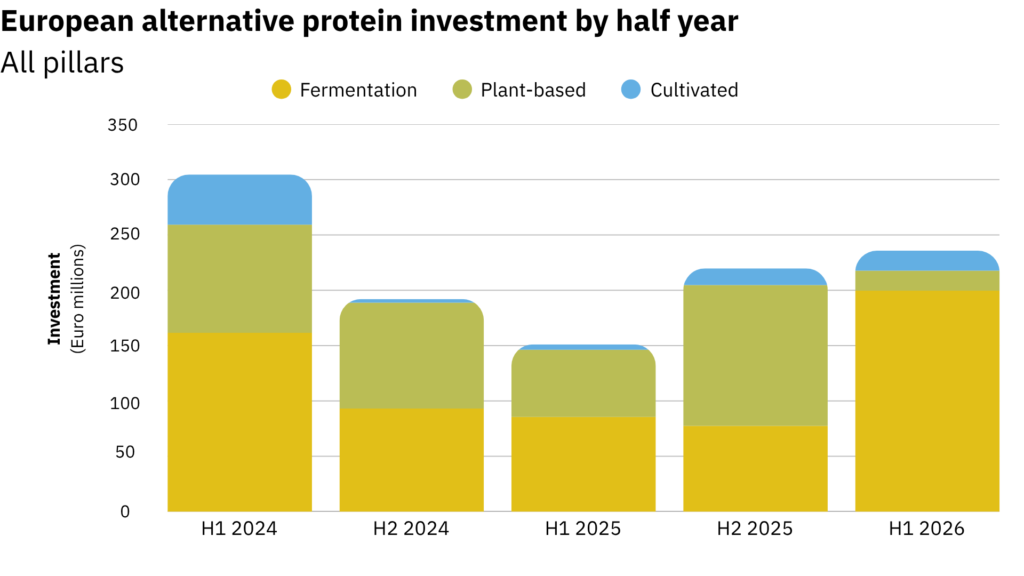
Fermentation has been leading Europe’s investment wave for a couple of years now, and this year has been no different. Precision fermentation startups, which genetically engineer microbes to produce bioidentical dairy and egg proteins in bioreactors, secured €100M ($117M) in the first half of 2026, surpassing the entire total for 2025 (€97M/$104M).
Likewise, firms involved in biomass fermentation (the tech used to make products like Quorn’s mycoprotein) received €99M ($115M) in funding in the January-to-June period, well above the €61M ($70M) they brought in during all of 2025.
These investments were characterised by fewer, larger deals, like the €25M ($30M) raised by Verley (as part of a larger €32M round), the €30M ($34M) secured by fellow French precision fermentation startup Standing Ovation, and the €18M ($21M) that Dutch biomass fermentation company The Protein Brewery attracted in its Series B extension.
In addition, fermentation firms collected €67M ($77M) in grants in the first half of 2026, a significant jump from the €45M ($52M) raised by the entire sector (including cultivated meat and plant-based companies) in the same period last year.
In some cases, such as Verley’s, public investments were combined with private financing and government-backed loans. The most prominent example of this was Solar Foods, which secured a €78M ($89M) funding package from Business Finland to build a commercial-scale factory for its Solein gas protein.
Likewise, the European Innovation Council’s accelerator programme provided €12.5M ($14M) – combining a grant with equity funding – to help Dutch startup Vivici scale its precision-fermented dairy proteins.
And a Europe-wide consortium led by British firm Adamo Foods secured a €10M ($12M) grant under the EU-funded Circular Bio-Based Europe Joint Undertaking to scale up a mycelium steak product
Plant-based companies lag behind as experts advocate for blended finance
The cultivated meat sector has seen its fair share of funding challenges and closures, though investment in Europe exhibited positive signs this year, totalling €18M ($21M). That’s already close to the €20M ($23M) this segment brought in throughout the whole of 2025.
Still, investment in cultivated meat remained below its 2023 peak, which Grosshans said demonstrates a need to diversify funding sources to secure a path towards commercialisation. Companies that led this growth include UK startup Meatly, which raised €12M ($14M), and Germany’s Innocent Meat, which secured €6M ($7M).
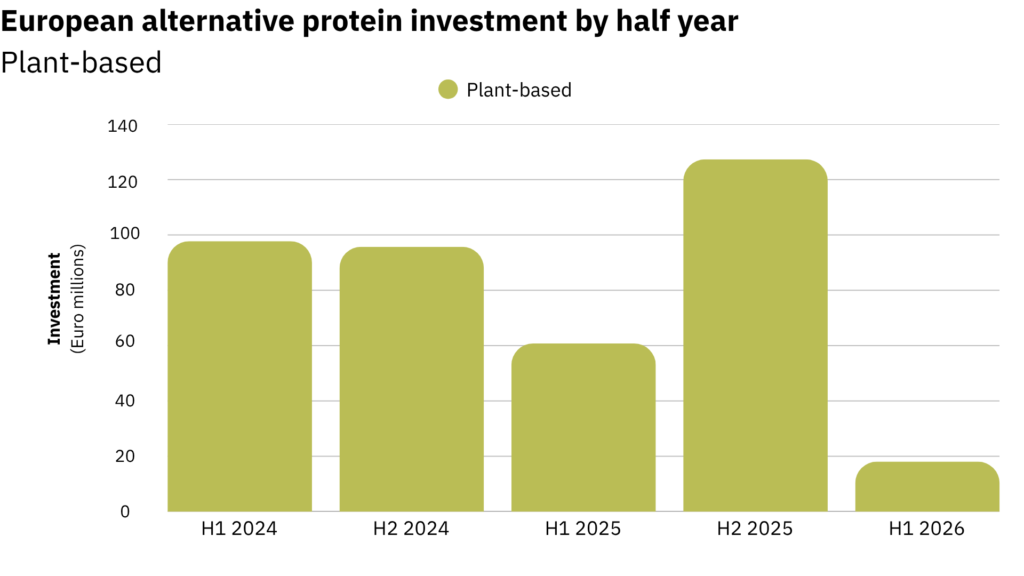
Plant-based companies represented the one pillar that has performed poorly in 2026, with funding falling off a cliff from €61M ($67M) in the first half of 2025 to €18M ($21M) in the same period this year.
“In this constrained investment climate, some plant-based companies are consolidating, with smaller startups being acquired by larger players or merging with one another to reduce costs,” explained Grosshans. “Others have moved beyond early-stage innovation and are trying to secure funding to move from pilot plant to industrial capacity.”
This kind of infrastructure is urgently needed by alternative protein companies and remains rare across Europe, so investors don’t have sufficient examples to confidently underwrite the risk of betting big on these companies. That highlights the need for new funding mechanisms to help construct future food facilities.
GFI Europe convened over 40 leading investors to propose new ways to overcome these challenges. The discussions revealed that agrifood innovation doesn’t fit the usual investment mould, in which companies are expected to grow rapidly and deliver strong returns within a few years.
Blending different types of finance, like grants, loans and equity, could reduce the risk of scaling up by spreading it across a wider set of investors. Public money could also be used more strategically – rather than replacing private capital, it could give investors greater confidence to fund plant-based companies through their scale-up journeys.
Grosshans warned that none of alternative proteins’ climate and health benefits would materialise if Europe’s future food sector stayed in the development phase. “With so much at stake for food security, climate goals and public health, we cannot leave protein diversification to the whims of the market,” she said.
“Europe’s fermentation companies demonstrate that this kind of blended, risk-shared financing has a role. The challenge now is to expand that approach to deliver a more resilient and sustainable food system.”