

Cultigen Group Connects B2B Cultivated Meat Platforms Under New Research Layer


UK company Cultigen Group has joined its marketplace, research and pricing platforms for cultivated meat into a Research Layer for scientists.
Cultigen Group, which is building a series of tools to help cultivated meat innovators commercialise, has launched a new Research Layer that connects three of its platforms.
The UK startup has brought B2B marketplace Cellbase, R&D intelligence platform Cellag Bio, and price reporting site Assay Markets together into one live data layer, which can help scientists find solutions to their bottlenecks under one streamlined platform.
The three tools now exchange data automatically and link directly to each other. At the core of the new data layer is the Cellbase Product Finder, which answers researchers’ questions with matching published studies, explaining what each one entailed, which components were used, and which Cellbase products supply them.
“People often ask me why I keep building separate businesses instead of one,” said Cultigen Group founder David Bell. “This is the answer. Each one was built to stand on its own, and each was also built to plug into the others. This is the first time you can see them working as one system.”
How the Research Layer will help cultivated meat scientists
Cultigen Group unveiled its first platform in mid-2025, a consumer-facing e-store for cell-cultured proteins called Cultivated Meat Shop. The move was anticipatory, since regulatory hurdles have meant that only a handful of companies are able to sell these foods right now (and none for human food in Europe).
Months later, it launched Cellbase, which connects suppliers of bioreactors, growth media, scaffolds, cell lines, sensors, and processing equipment with cultivated meat startups and researchers. Its first cohort of partners included Multus, Sallea, Quest Meat, and Cellcraft, among others.
Cellbase now lists more than 500 products from over 50 suppliers, featuring deep taxonomies, advanced filtering, search, and comparison via structured metadata parsing, full e-commerce functionality (online ordering, cart and checkout); comprehensive marketplace infrastructure (order management, automated payouts, account dashboards, etc.), and multiple suppliers across categories.
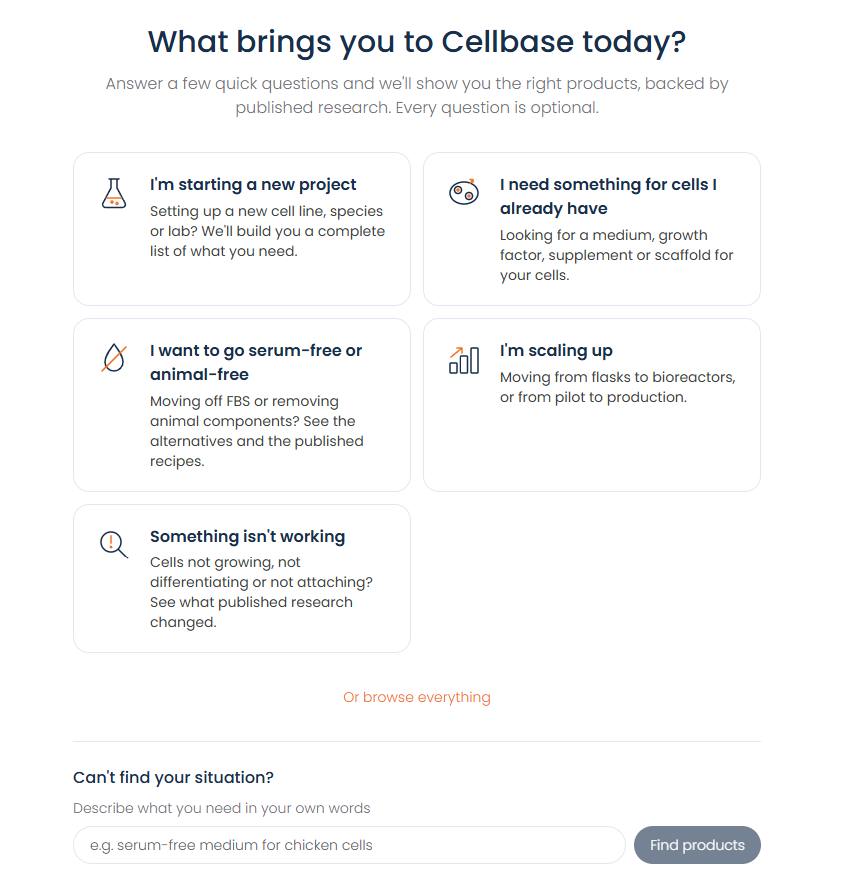
On the Cellbase Product Finder, scientists can choose from five starting points: beginning a new project, finding inputs for cells they already have, going serum- or animal-component-free, scaling up, or fixing a problem. The platform then runs through all three datasets, analysing studies, prices and products to present an evidence-backed shopping list for researchers.
This was followed by the rollout of Cellag Bio earlier this year. This uses artificial intelligence (AI) to pull structured data from scattered scientific research, passes it through editorial review, and publishes “decision-ready” experiment records of species, cell types, media, components, results, and failure modes, enabling companies to move faster and avoid burning capital on known pitfalls.
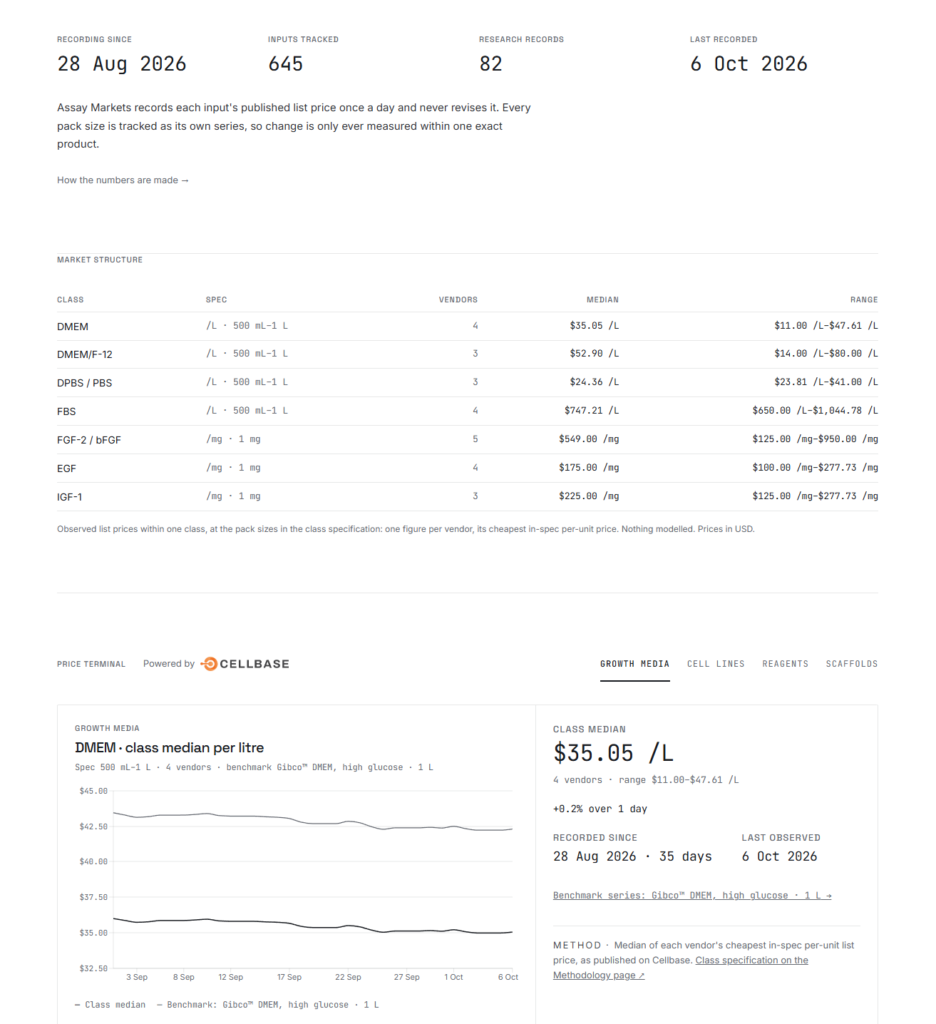
And in August, it introduced Assay Markets, a neutral price-reporting tool that records a timestamped price series for production inputs and answers plain-language questions through its Ask box.
“Each one answers a different question a lab has,” Bell explained. “Cellbase is what you can buy. Cellag Bio is what has actually worked. Assay Markets is what it costs. On their own, they’re useful. Joined up, they answer the question scientists actually ask, which is: what should I use, and why?”
Cultigen Group plans more layers for cultivated meat industry
Cultigen Group built a shared vocabulary and component dictionary to standardise information across the three datasets, with reviewed product matches, hundreds of aligned fields and automated integrity checks.
The company said deeper links between the three platforms are set to follow in the coming weeks, and plans to build three more layers to serve the commercial infrastructure for cultivated meat.
Next in line is the Intelligence Layer, which covers the players, investors and trends in cultivated meat. Due to launch by the end of the year, this combines Cultideck, an intelligence directory of regulatory progress, investments and supplier capabilities; The Growth Medium, a searchable repository of official company announcements, funding rounds and milestones; and a third unannounced venture.
All three will run on one shared registry of companies, financing and regulatory activity, and will be connected to each other and the Research Layer in the same way as the latter’s components. Cellbase’s supplier base and Assay Markets’s will feed directly into these datasets. This will be followed by a Production Layer and a Market Layer.
“The Research Layer is the proof of concept. The Intelligence Layer is being built the same way, on shared data from day one. Each layer we add makes the ones before it more valuable,” said Bell.
“Right now, the job is getting scientists what they need, faster. The consumer side of cultivated meat comes later and needs a different set of tools. But it’s all one plan, and this is the first layer of it.”
The move comes weeks after Cultigen Group partnered with the Association for Meat, Poultry and Seafood Innovation, a US-based cultivated meat trade body, to help companies boost their R&D and commercialisation efforts.