

UK Scientists Use AI to Identify Nearly 800 Plant Proteins for Sustainable Food

Scientists at the UK’s government-backed National Alternative Protein Innovation Centre have used artificial intelligence to pinpoint hundreds of plant-based proteins that can act as emulsifiers in food and personal care products.
The role of artificial intelligence (AI) in ingredient discovery is becoming increasingly prominent, with the technology significantly cutting the timelines and costs associated with such research.
Now, scientists in the UK have combined this technology with statistical physics to develop a new approach that can rapidly identify plant proteins with the potential to act as emulsifiers.
The team at the University of Leeds’s National Alternative Protein Innovation Centre (NAPIC) have recognised nearly 800 such plant-based proteins, many of which had not been considered for this purpose.
They say the research could address the challenge of identifying promising proteins without having to test millions of individual possibilities in the lab, which is a major bottleneck for the development of new sustainable ingredients.
How NAPIC researchers tapped AI to explore plant proteins
Emulsifiers are crucial for combining oil and water and maintaining the stability of everyday products. They’re used in foods like ice creams, sauces, and mayonnaise, as well as cosmetics, pharmaceutical, and other industrial applications.
The NAPIC researchers point out that there’s growing interest in developing natural, more sustainable alternatives to the current crop of emulsifiers, which are often sourced from animal proteins like milk (think whey or casein) and eggs.
Here’s the problem, though: since there are millions of plant proteins with useful functional properties, finding the most suitable ones via conventional lab testing can be expensive, time-consuming, and heavily reliant on trial and error.
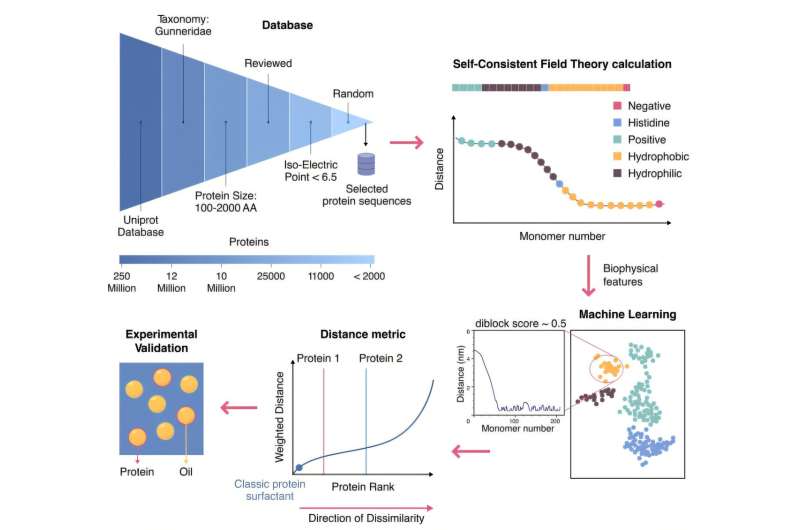
So the scientists were on the hunt for a faster, more reliable way of predicting which plant-based ingredients could be effective emulsifiers. They first used a simulation model based on statistical physics to understand how proteins interact with oil and water interfaces – for a protein to work as an emulsifier, it needs to attach at the interface between oil and water and help stabilise the mixture.
They then employed machine learning to identify specific sections and characteristics of proteins that influence this behaviour. By combining these two technologies, they were able to predict which plant-based sources were likeliest to demonstrate emulsification properties similar to animal proteins.
According to NAPIC, the computational approach means researchers can narrow down the number of potential plant proteins to those most worthy of further lab investigation, potentially cutting back on years of conventional trial-and-error testing.
AI changing the game for ingredient discovery
After discovering the nearly 800 ingredients, the researchers tested several commercially available proteins to see if the experimental results matched the model’s prediction.
The outcome, they said, was promising. Pea and potato proteins, for instance, demonstrated effective emulsifying properties and supported the predictions made by NAPIC’s AI-led approach. It proved that AI could help researchers identify promising new ingredients much faster than conventional approaches.
This method of discovery could be valuable for plant-based and sustainable food developers, who can identify functional ingredients from a vast pool of potential sources.
Computational approaches could therefore accelerate product development and lower the time and resources required during early-stage research. The research also showcases the potential of bringing together different areas of expertise, including food science, protein chemistry, statistical physics, and AI, to address the challenges of the protein transition.
NAPIC, which was founded in 2024 through a £38M investment (£15M of which came from the British government), isn’t the only one using AI for this purpose. Chile’s NotCo is perhaps the most famous example, pivoting from being a CPG company to an AI startup that helps food companies accelerate product development, including the likes of Nestlé and Mars.
In the US, Shiru is using the tech to discover new sustainable proteins and ingredients, while Food System Innovations has launched an Food Intelligence Lab to develop open-source infrastructure to accelerate AI-driven alternative protein development