

Seven in 10 Americans Want to Avoid UPFs, As Most Label Them A Threat to Public Health

Most Americans believe ultra-processed foods are a significant threat to public health and are trying to avoid them, a new survey has shown.
Ultra-processed foods (UPFs) “manipulate” consumers by creating a sense of disconnection between knowledge, behaviour, trust and control, according to a new report outlining the intention-action gap in Americans’ food choices.
Google searches for UPFs have skyrocketed since 2022, and no other aspect of food – whether it’s organic or non-GMO or even sustainable – has taken on a deeper meaning for consumers than processing in the last decade.
These trends come as studies link UPFs to a host of health conditions, with UPFs becoming synonymous with junk food, despite many experts cautioning against associating the level of processing with a food’s nutritional value.
The result? Over seven in 10 Americans (72%) are trying to avoid UPFs in their diet, and this intention remains strong even among those who don’t know much about these foods (57%).
The 1,000-person poll was conducted by Linkage Research on behalf of Food Integrity Collective, a natural products group part of the Non-GMO Project, which is behind the recently launched Non-UPF Verified certification label.
“What we see is a troubling disconnection in several different but deeply related ways: a disconnection from the intuitive knowledge that good food is nourishing; an aspirational disconnection in realising and exercising this intuition, due to barriers in the culture and in the marketplace; and an emotional disconnection in the social fabric of trust,” the report states.
Food processing top of mind for Americans
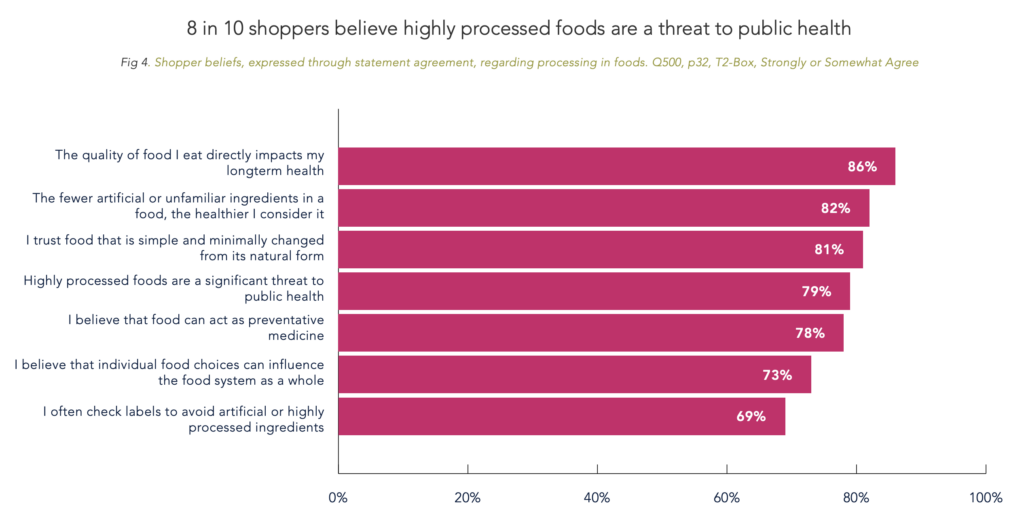
The survey found that 79% of Americans feel UPFs are a “significant threat” to public health, while 82% believe the fewer artificial or unfamiliar ingredients a food has, the healthier it is. Plus, 69% check labels to avoid highly processed ingredients.
In fact, how processed a product is has considerably more impact on people’s purchasing decisions (57%) than other attributes. It’s why food companies have begun promoting non-UPF products – in the last three years, ‘minimally processed’ claims on new products have increased by 30%.
One of the four disconnections created by UPFs, the report argues, is a knowledge gap: shoppers are interested in non-UPF foods, but they don’t know how to identify them, highlighting the confusion created by the overly broad description of the category by the Nova classification. For instance, only half of shoppers consider soft drinks UPFs, falling to 19% for protein bars.
Still, 37% of respondents think they’re very or extremely knowledgeable about UPFs, indicating that they “may not be aware that their knowledge is incomplete”. That said, 83% are interested in learning more, representing a “striking opportunity for the natural food industry, regulators and retailers to provide resources to close the knowledge gap”.
Americans consume way more UPFs than they think
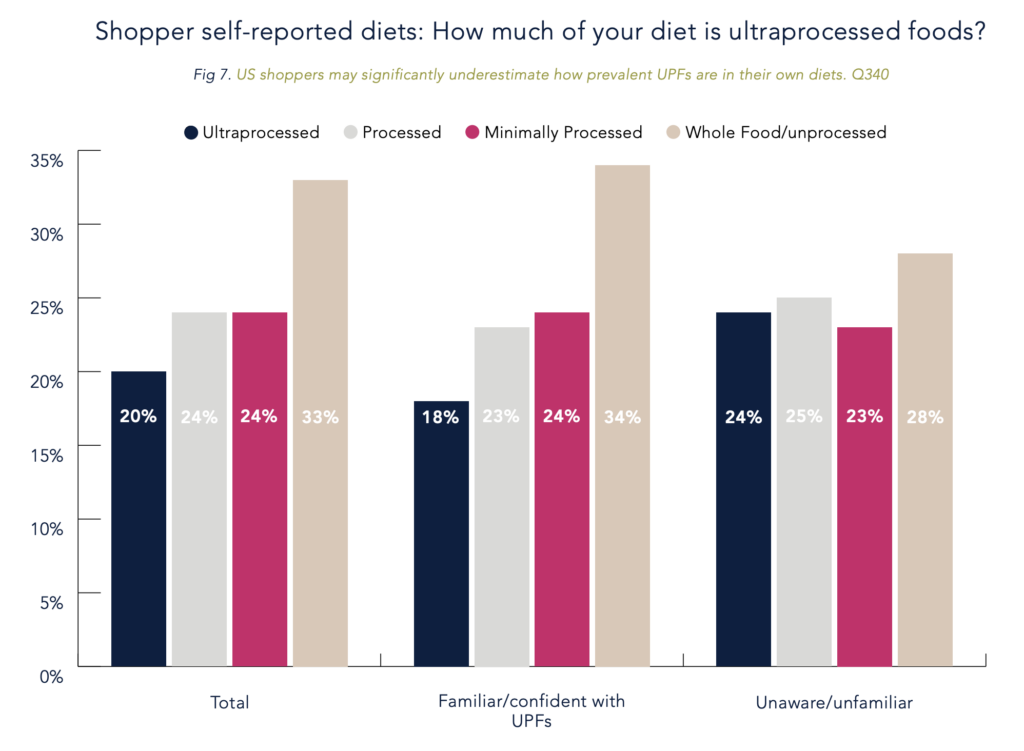
At the same time, most Americans underestimate how much of the food they consume is ultra-processed. Research shows that this figure lies at nearly 60%; in this survey, shoppers said only 20% of their calorie intake is composed of UPFs.
“On the one hand, this may suggest that they don’t perceive the broader public health concerns about UPFs to be impacting them in their own choices. On the other hand, it compounds the fact that they are clearly having trouble applying limited knowledge to their lived experience,” the report said, labelling this the behavioural gap.
Another lever of disconnection stems from the “steep decline in trust” in governments, institutions and corporations, amplifying an entrenched scepticism about marketing and portraying large companies as putting profit over public interest.
Social media influencers (5%), food companies (8%), and AI (9%) are the least trusted sources of food information in the US, with policymakers (10%) not far behind. Instead, the people Americans have most faith in are doctors, farmers (42% each), scientists (44%), and themselves (53%).
What’s keeping Americans from reducing UPFs?
When identifying the barriers to making better food choices, Food Integrity Collective suggested that consumers feel a sense of disconnection in their own agency. This is highlighted by the 61% of Americans who wish they had more control over what’s in the food they buy, rising to 71% among those actively trying to avoid UPFs.
Some of the biggest obstacles they cited are cost and time constraints (55%), a lack of family or community support (58%), and a lack of good luck (40%), in terms of having a good store nearby or someone to help.
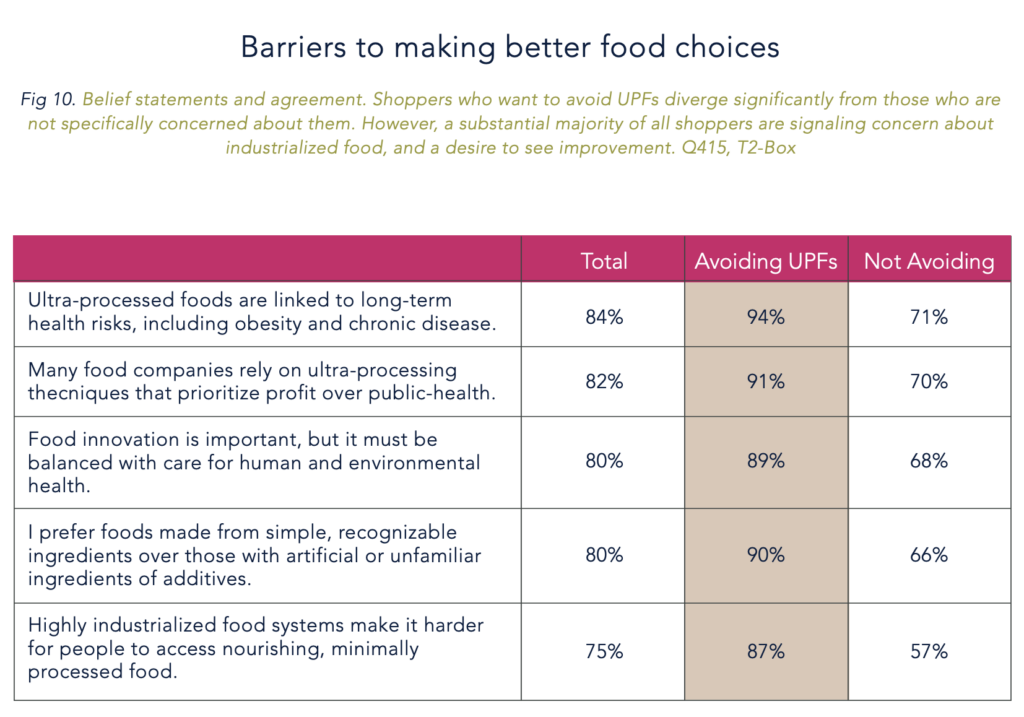
Overall, 84% of respondents believe UPFs are linked to long-term health risks, 82% think food companies rely on overprocessing techniques to increase profits, and 80% prefer familiar ingredients over artificial additives. These sentiments become more popular with people trying to stay away from UPFs.
Two-thirds of Americans avoiding UPFs regularly read product labels, and 59% of shoppers say they’re much more likely to buy a product carrying a non-UPF certification.
It underscores the reasons behind Food Integrity Collective’s introduction of the Non-UPF Verified certification, which brands can use as an on-pack label to definitively highlight a product’s non-UPF status. It is currently developing a code of standards alongside a trial with 16 brands, the results of which will be published this week.
How brands, retailers and policymakers can address UPFs
To help address the four gaps, the report recommends brands highlight less processed ingredients and explain processing transparently, reformulate products to cut out artificial ingredients, and partner with scientists and farmers to co-develop messaging.
Retailers should provide shelf tags, in-store signage and digital resources that explain what UPFs are, increase non-UPF products (including via their private-label brands), and create in-store community events, food demos and learning opportunities to make healthy eating social and accessible.
Finally, policymakers should support the development of UPF definitions and labelling frameworks, incentivise healthy food choices through subsidies, procurement, and programmes like produce prescriptions, invest in local infrastructure to expand access to less processed foods in underserved areas, and incorporate public feedback and promote bipartisan support in regulatory actions.
It’s important to note that many health experts and organisations, including the American Heart Association, have stated that all UPFs are not equal, and several such products can actually be good for you. Many scientists argue that research linking them to ill health is often misleading.
This is why standardised definitions are critical. Some have also created alternatives to the Nova classification that first grouped food by their method of processing, including a project backed by the Novo Nordisk Foundation.
The US government is already working on developing a definition of UPFs, while states like California, Arizona and Louisiana have imposed a ban on these products in schools. And just last week, another certification body, the Non-UPF Program, opened up its scheme to the entire food industry.