

Cigarettes, Super Bowl & Oat Milk: Food Industry Claps Back As UPF Discourse Intensifies

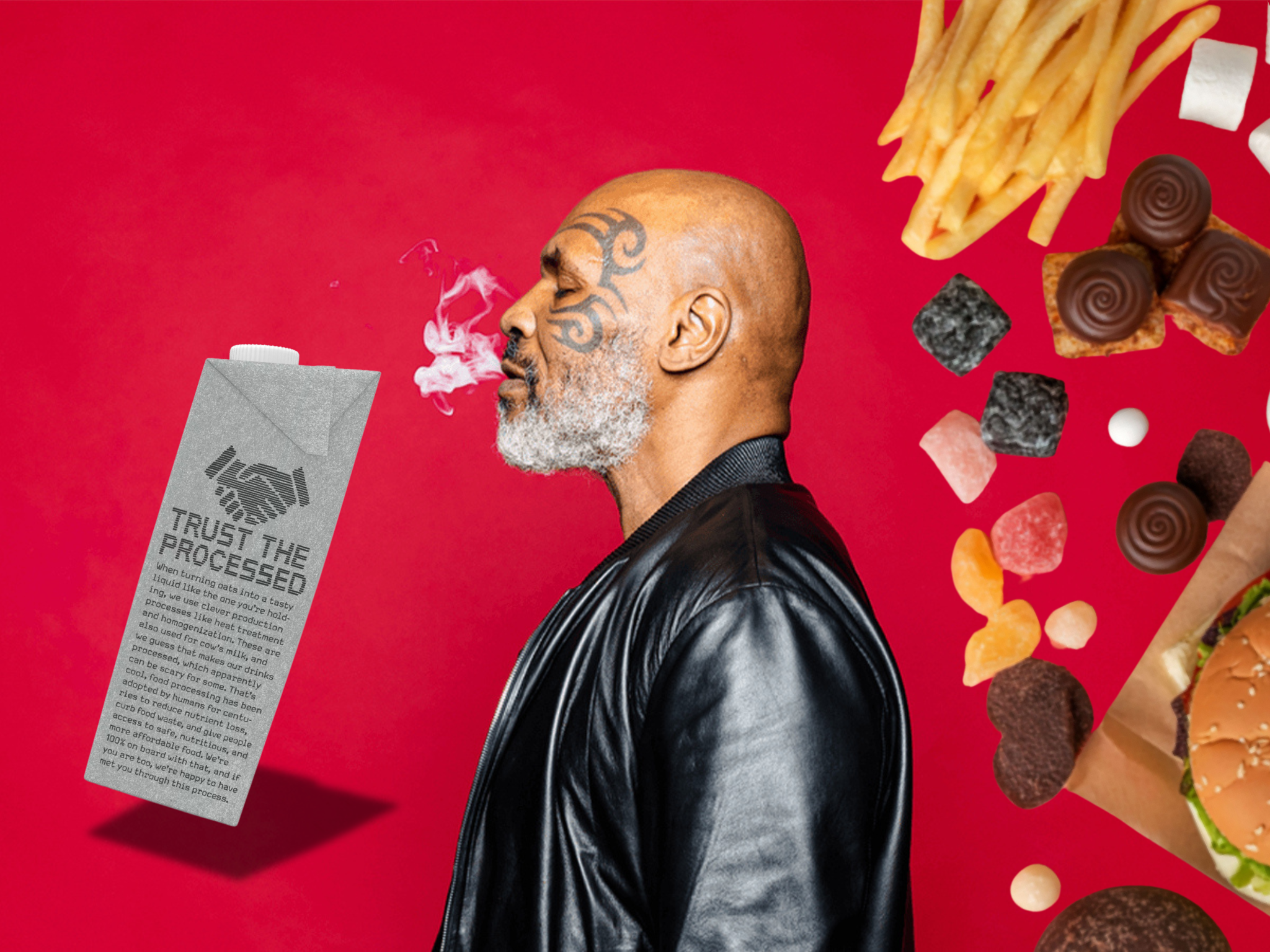
The debate around ultra-processed foods has been taken up a notch, with comparisons to cigarettes and a Super Bowl ad contrasting with Oatly’s embrace of the ‘processed’ label.
You know ultra-processed foods (UPFs) have breached the mainstream when they’re the subject of an $8M Super Bowl commercial starring boxing legend Mike Tyson.
In the 30-second spot, Tyson makes a good point: junk food is driving America’s uncontrolled obesity crisis, and we need to do something about it.
The problem, however, is that he conflates junk food with UPFs. He’s not the first one – this link is the bedrock of all the confusion that surrounds these foods – but he is one of the most well-known public figures to do so. And he did it on the most coveted TV slot of the year.
“I had so much self-hate… I just wanted to kill myself,” the boxer said while recalling his old eating habits. “Something has to be done about processed food in this country,” he added while eating an apple.
“Processed foods are killing us. We have been lied to and we need to eat real food again,” Tyson tweeted alongside the video.
If those words feel familiar, it’s because they’ve been plastered all over the MAHA-fuelled conversation about food in the US. The new national dietary guidelines have been critical of UPFs and are literally housed on a website titled ‘Eat Real Food’.
The most important fight of my life isn’t in the ring.
— Mike Tyson (@MikeTyson) February 6, 2026
I’m not fighting for a belt. I’m fighting for our health.
Processed foods are killing us. We have been lied to and we need to eat real food again. pic.twitter.com/vnxHoCqHTJ
So it’s no surprise that Tyson’s Super Bowl commercial was paid for by MAHA Center Inc, a non-profit aligned with Robert F Kennedy Jr’s health movement.
The stunt comes shortly after a new study that suggests UPFs have more in common with cigarettes than whole foods, the latest instance in the misguided connection between processing and nutrition.
The food industry, as is its wont, has been fighting back – mostly with strongly worded statements that don’t do much to move the needle. However, oat milk pioneer Oatly is taking a different approach, embracing the UPF tag on its packaging to help educate consumers about the nuances.
Cigarettes, really?
UPFs were first defined by the Nova classification developed by researchers in Brazil in 2009, who described them as products made with industrial formulations and techniques or containing cosmetic additives thought to be of little culinary use. Put simply, they’re thought of as foods you can’t make in your home kitchen.
Americans now get 55% of their calories from UPFs, which many experts have linked to a multitude of health ailments (and even premature death). The latest research to add to the scrutiny comes from Harvard University, the University of Michigan and Duke University.
The paper draws on addiction science, nutrition and public health history to suggest that marketing claims like ‘low-fat’ or ‘sugar-free’ are reminiscent of how filtered cigarettes were advertised in the 1950s – in practice, these products “offered little meaningful benefit”, claimed the authors.
“Many UPFs share more characteristics with cigarettes than with minimally processed fruits or vegetables and therefore warrant regulation commensurate with the significant public health risks they pose,” they wrote.

However, critics warn that the study risked overreaching in its comparisons. “Depending on the characteristics used, that might be true,” Gunter Kuhnle, professor of nutrition and food science at the University of Reading, said of the above claim.
“Is it processing? In that case, even processed foods (Nova 3) probably share more characteristics with cigarettes than vegetables. Is it palatability? UPF definitely shares more characteristics with vegetables.”
His view aligns with that of many health and nutrition experts, who argue that connecting UPFs with ill health is misleading because the category is too broad. Here’s a short list of things the Nova classification calls ultra-processed: chicken nuggets, canned soups, Oreos, fortified plant-based milk, a Beyond Burger, and whole-grain bread.
Does soy milk with vitamins, minerals and lecithin – high in both protein and fibre – really have more in common with cigarettes than fruits and vegetables? Does eating a bowl of sugar-free breakfast cereal have the same effect on your body as smoking what has rightfully come to be known as a cancer stick? Most people know the answer is no, but the way we talk about UPFs blurs the line.
Oatly ‘on board’ with being ultra-processed
The muddled discourse around UPFs is why 72% of Americans are trying to avoid UPFs in their diets, and 79% feel they’re a “significant threat” to public health, according to research commissioned by Food Integrity Collective.
But, as the American Heart Association warns, not all UPFs are equal, and several such products can actually be good for you, including plant-based meat and dairy alternatives. One of the biggest purveyors in this category, also riddled with the UPF label, is tackling the situation head-on. Late last year, Oatly re-tuned the packaging of some of its oat milks to include a blurb titled ‘Trust the Processed’.

“When turning oats into a tasty liquid like the one you’re holding, we use clever production processes like heat treatment and homogenization. These are also used for cow’s milk, and we guess that makes our drinks processed, which apparently can be scary for some,” the label reads.
“That’s cool, food processing has been adopted by humans for centuries to reduce nutrient loss, curb food waste, and give people access to safe, nutritious, and more affordable food. We’re 100% on board with that,” Oatly declares.
While it’s a bold strategy that has the risk of backfiring – openly acknowledging your product is ultra-processed may not sit well with some consumers – it can expand education and help quell the often unfounded fears around UPFs.
“When we chose to address this topic on our pack, we anticipated debate and that’s part of the intent. Packaging is one of our most powerful comms tools, we’ve often used it to engage with issues bigger than ourselves,” Caroline Orfila Jenkins, VP of science and technology at the company, wrote in a LinkedIn exchange.
Current opinions around UPFs are polarising, offering simplistic yet confusing narratives about food processing which are – in my view – distracting us from tackling the integrated challenges of climate change and food injustice. We choose to speak openly and transparently about this topic and continually partner with expert voices, such as nutritionists and dieticians, to get the facts out there,” she added.
Jenkins further pointed out how fortified plant-based milks like Oatly are recommended in the US dietary guidelines. This document – heavily criticised for its emphasis on red meat and dairy – informed the content of Tyson’s Super Bowl ad too, outlining just how convoluted the UPF debate is. Can Oatly become a trailblazer in clearing the misinformation and simplifying the conversation?