

These Are the Top Countries for Plant-Based Eating, According to The Vegan Society


The US leads the world in the number of alternative protein producers, but countries in Asia-Pacific show strong consumption and availability trends for plant-based food.
Despite the negative media coverage, in the eyes of consumers, veganism isn’t the food industry’s Big Bad Wolf, according to a new report.
Polling conducted by The Vegan Society reveals that people’s feelings towards the lifestyle are mostly neutral, and actually lean positive in most cases. Even in Japan, where feelings skew more negative, most respondents still had neutral to positive outlooks on veganism (52%) and vegans (59%).
The findings are part of the charity’s Veganism Around the World report, which combines international research with its own survey of around 2,000 global participants to offer an insight into the growth of plant-based eating.
“This report is the first comprehensive investigation into the growth of veganism around the world,” said Claire Ogley, head of campaigns, policy and research at The Vegan Society. “The data shows that veganism is no longer a niche movement but is gaining traction cross-culturally with restaurants, businesses and consumers driving its growth globally.”
Who has the highest number of meat-free eaters?
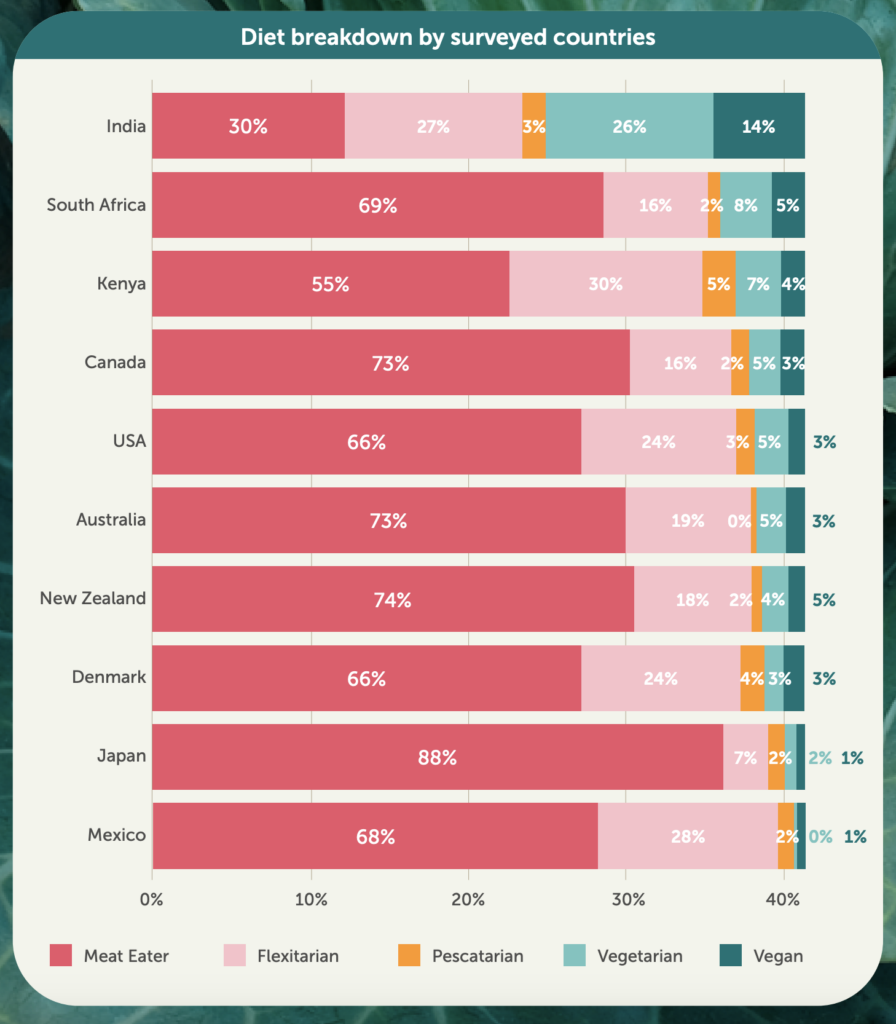
According to The Vegan Society’s polling, only a small share of the global population is vegan, but flexitarianism is thriving. Barring Japan, 16-30% of people identified as flexitarians in each of the other 10 countries in the survey.
India houses the highest share of meat-free eaters globally, with 14% saying they’re vegan and another 26% vegetarian. This exceeds other estimates, but the authors caution that the small sample sizes in the report leave room for “significant margins of error”.
Still, the world’s most populous nation has a more favourable attitude towards meat-free eating than any other country, with 76% of respondents reporting positive feelings towards vegans and vegetarians.
The US, Canada and Australia all have 3% of consumers identifying as vegan and another 5% as vegetarian. In New Zealand, this stands at 3% and 4%, respectively.
Meanwhile, The Vegan Society found that veganism was best understood in Australia, where 64% of respondents identify the lifestyle as one that excludes food, clothes and other products derived from animals. This is followed by India (57%) and New Zealand (52%).
Across the board, the share of people who say they didn’t know what the lifestyle involves is low, with most suggesting that veganism entails abstaining from animal-based foods. The only exception here is Japan, where a fifth of consumers don’t understand what the term means.
The Vegan Society also used Google Trends data as a “rough proxy” for interest in veganism, finding that search interest for the term has stabilised after reaching a peak in 2020. In fact, it continues to outpace vegetarianism and, aside from some short bursts of heightened interest, even climate change.
Which countries have the most vegan restaurants and companies?
Aside from the consumer insights, the report looked at where alternative protein innovation is thriving from a business and innovation perspective. The US has the highest number of companies in this sector, with 538 plant-based firms and 77 cultivated or blended meat players.
But when it comes to alternative protein businesses per capita, Singapore leads the way with 7.44 plant-based and 2.37 cultivated or blended meat companies for every million people. This is closely followed by Israel (6.66 vegan and 2.36 cultivated and blended protein firms). The US, with 1.84 alternative protein players per million citizens, is low on the list.
This trend is mirrored by the foodservice industry too. The US has, by far, the most restaurants with plant-based options (47,865), followed by the UK (20,705). But New Zealand has the most vegan-friendly dining environment per capita (344.81 per million people), with Australia (309.89) and the UK (302.93) not far behind.
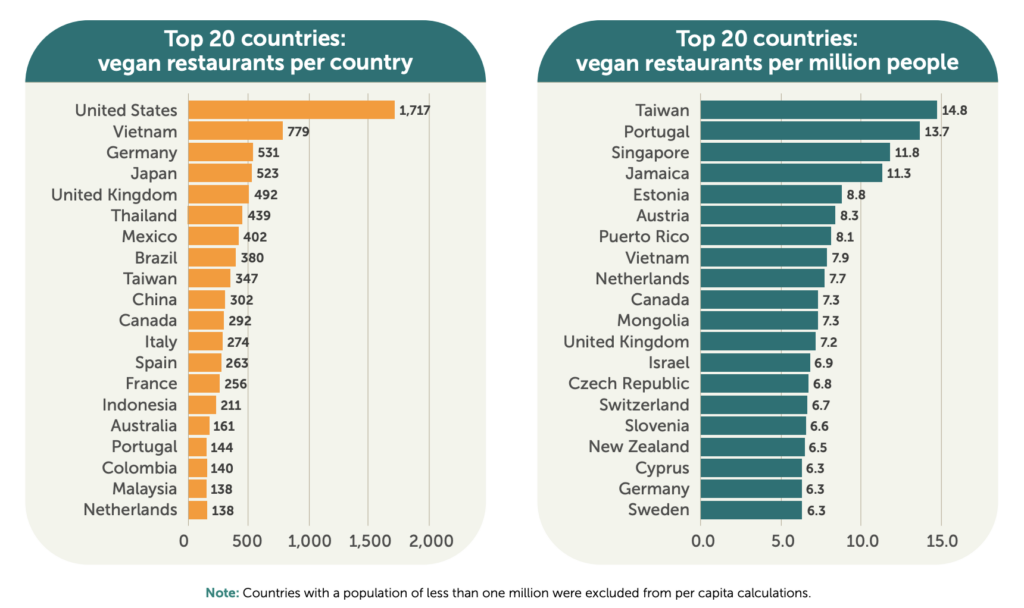
In terms of fully vegan eateries, the US tops the list with 1,717 such establishments, followed by Vietnam’s 779 plant-based restaurants. Per capita, however, Taiwan is a trailblazer with 14.8 vegan restaurants for every million people, followed by Portugal (13.7).
Many countries simultaneously have extremely high meat consumption rates and a large presence of vegan restaurants. For instance, the US is the third-highest consumer of beef per capita, but has more vegan-friendly eateries than any country. And Portugal has both the second-greatest number of vegan restaurants per capita and the third-highest seafood intake rate per capita globally.
“Restaurateurs and alternative protein entrepreneurs both must strike a delicate balance. They need to identify areas where existing businesses have thrived, signalling a robust market, while simultaneously steering clear of oversaturation,” the authors wrote.
“[Alternative protein] companies have a unique dynamic to consider because they can be based in a country with favourable business conditions, but not be confined to selling in the same country. These businesses should therefore also consider how exporting fits into their business model.”