

UK Plant-Based Meat Brand This Unveils Fact-Led Knowledge Hub to Fight Misinformation

British plant-based meat maker This has launched an evidence-led online knowledge hub for consumers to navigate misinformation about protein, processing, nutrition and sustainability.
The meat industry has spent millions on research papers and ad campaigns that smear plant-based alternatives, breeding negative perceptions about their health and environmental credentials.
Much of that is misinformation designed to protect livestock producers’ bottom lines and ward off a competing industry, an effort further fuelled by social media “super-spreaders” in cahoots with Big Meat.
Many of these online influencers belong to the manosphere, an extremely influential side of the internet that has seen young men eat up misinformation and meat with a side of misogyny. Figures like Jordan Peterson, Andrew Tate, ‘Liver King’ Brian Johnson, and Joe Rogan, for instance, have promoted the carnivore diet and spread dangerous misinformation about its health impact.
In the UK, this has had a profound impact on young men, who feel uncomfortable eating plant-based food in public, and are three times more likely than the general population to have increased their intake of meat last year.
To cut through that noise, London-based startup This – known for its plant-based meat and protein innovations – has built an online knowledge hub that collates information about the nutrition and sustainability impact of animal-free foods and answers some of the most pressing questions about the category.
The evidence-led platform, titled “100% Plant-Based. 100% Fact-Based.”, aims to help consumers make more informed decisions by exploring data around protein, fibre, saturated fat, iron, and vitamin B12, climate footprint, and animal welfare.
“Food has become incredibly confusing. Every day consumers are bombarded with headlines, social media advice and conflicting opinions telling them what they should or shouldn’t eat. We’ve created a place where people can explore the facts for themselves,” said This CEO Mark Cuddigan.
This’s knowledge hub covers nutrition, sustainability and animal welfare
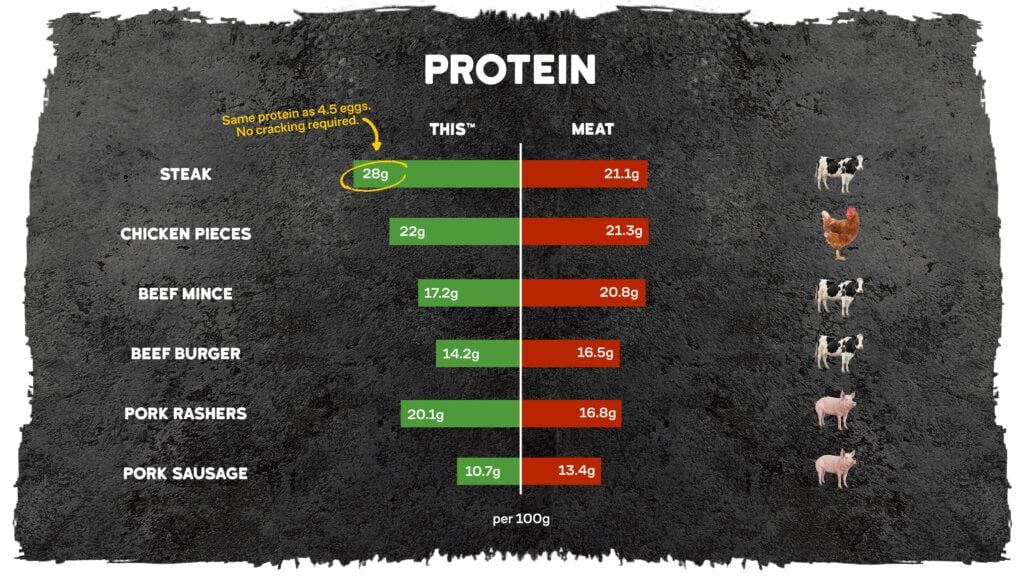
The new platform is designed around the three pillars of nutrition, environmental sustainability, and animal welfare, with charts providing side-by-side comparisons of This’s products with their animal-derived counterparts.
The company highlights how its plant-based meats fare on the protein scale, an increasingly important purchase driver for consumers. This’s steak, chicken pieces, and pork rashers all deliver more protein than conventional versions, but its beef mince, burger and pork sausage have slightly lower amounts of the macronutrient.
That said, all of its plant-based products contain far more fibre than meat, which mostly has negligible amounts of the macronutrient, even though 95% of Brits are deficient in it.
Its meat-free innovations also have a lower saturated fat content, and contain higher levels of iron than animal proteins. The latter is because the vegan alternatives have harder-to-digest non-heme iron, so your body needs more of it to match the iron from meat.
The only nutritional aspect in the analysis where all meat products outperform This’s analogues is vitamin B12, with the latter containing roughly half the amount of this vital micronutrient in most cases. In sausages, however, it’s present in nearly equal levels.
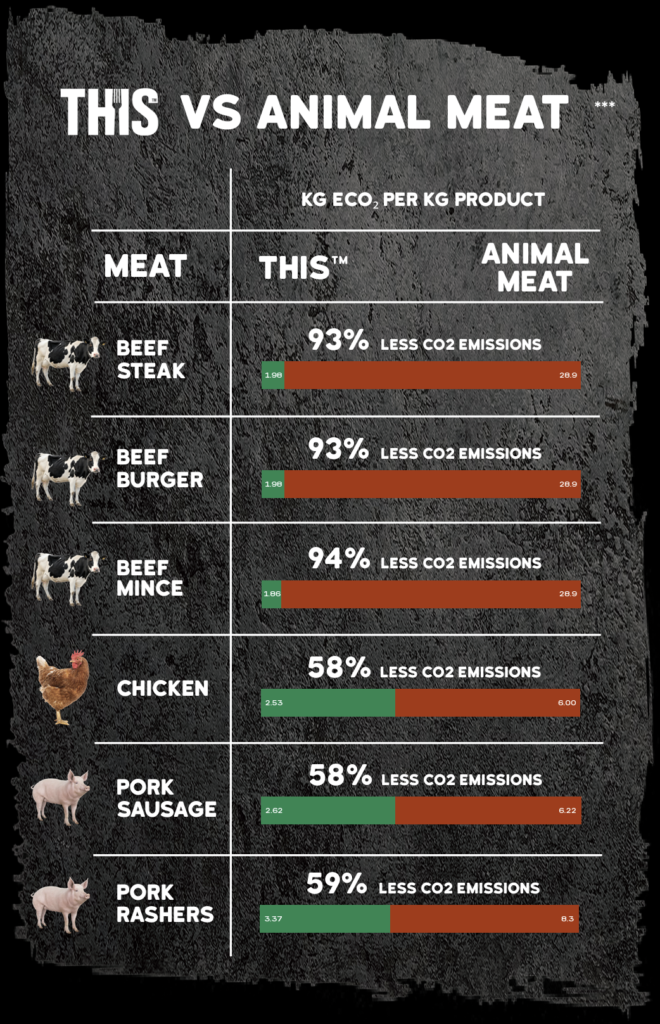
This’s products blow away meat when it comes to sustainability, emitting a fraction of the greenhouse gas emissions. For instance, the company’s vegan steak and burger generate 93% fewer emissions than beef, while its chicken and pork sausage have a 58% smaller footprint.
And on the animal welfare scale, This points out how its products don’t call for the rearing, slaughtering and transportation of animals. It cites UK government data showing that, in January alone, livestock producers slaughtered 96 million chickens, around 875,000 pigs and sheep, and over 160,000 cattle in the country.
Plant-based meat industry rallies against misinformation
Each nutrition-focused section of the knowledge hub contains FAQs to address consumer concerns, such as “Is plant protein as good as animal protein?” and “Why doesn’t meat contain fibre?”.
This noted that social media is “awash with conflicting opinions” on protein, processed foods, nutrition, and sustainability, leaving many consumers unsure of who or what to believe.
The company added that its aim is not to tell people what to eat, but instead encourage them to explore the evidence behind some of the biggest discourses around food today. “Whether you’re plant-based, flexitarian or simply curious, this platform is designed to answer common questions in a way that’s clear, balanced and easy to understand,” said Cuddigan.
It isn’t the first company to come out swinging against misinformation in the meat industry. In the US, Beyond Meat and Impossible Foods have long been embroiled in this battle – the former has consistently blamed the meat lobby’s efforts as a primary driver of its market decline.
In an earnings call last week, when Beyond reported an 8% year-on-year decline, founder and CEO Ethan Brown said the firm was “acutely aware that misinformation regarding the health of our products continues to impact our retail and foodservice businesses in the United States”.
Last year, it released a nine-minute film covering the meat industry’s misinformation campaigns, the health and environmental impacts of plant-based meat, and its effect on farmers, likening Big Beef to Big Tobacco. And this summer, it launched Don’t Believe the Cropaganda, a critically acclaimed mock smear campaign against its own products to highlight the misinformation they’re subjected to.
Impossible Foods, meanwhile, famously responded to the meat industry’s Spelling Bee-themed 2020 Super Bowl ad, which featured participants struggling with words like methylcellulose (an ingredient commonly used in meat alternatives), with its own parody where a child is asked to spell “poop”, ending with the line: “Just because a kid can spell ‘poop’, doesn’t mean you or your kids should be eating it.”
And much like This’s new platform, the Impossible Burger maker launched an online Health Hub in 2024, roping in nutritions and dietitians to bust myths about the health impact of plant-based meat.