

Oatly Hits First Full Year of Profitability After Losing UK ‘Milk’ Labelling Case

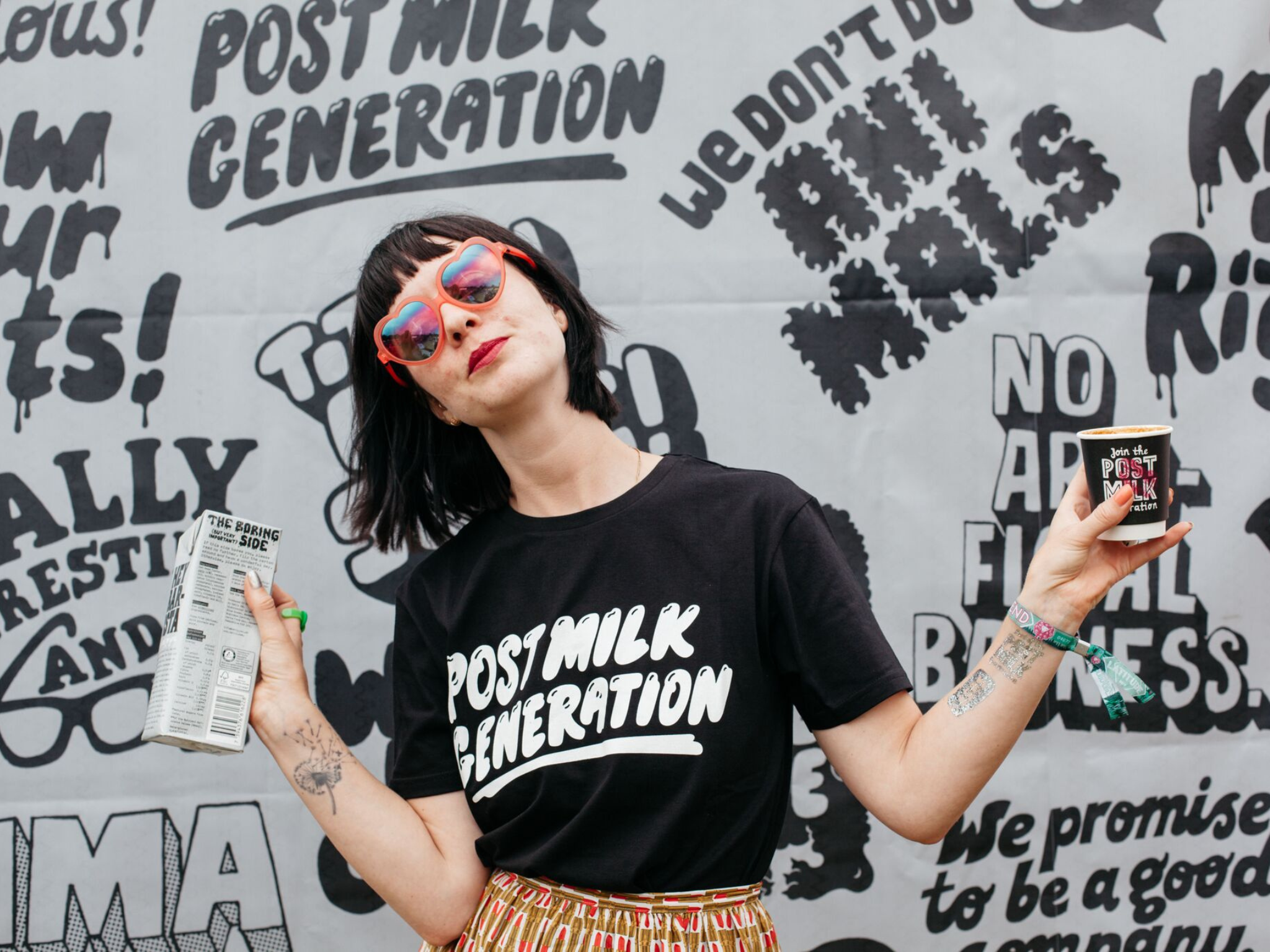
Oatly announced its first full year of profitable growth, with revenue increasing by nearly 5% in 2025, the same day it lost a UK court battle with the dairy industry over the labelling of oat milk.
Swedish plant-based milk giant Oatly achieved a major financial milestone in 2025, delivering its first full year of underlying profitability as a public company.
The firm’s revenues reached $862.5M last year, a 4.7% improvement over 2024. This followed its most productive quarter ever, with sales hitting $233.8M in Q4 2025 (a 9% increase from the same period a year prior).
Oatly’s adjusted EBITDA for the entire year – revenue excluding all non-operational and one-time expenses – stood at $6.5MM, compared to a loss of $35.3M in 2024. It sold more volume in 2025 than ever before (reaching 593 million litres), and saw its gross margin swell to 32% (three percentage points higher than 2024).
CEO Jean Christophe-Flatin called it a “milestone, not our destination”, and in an earnings call, he celebrated how the oat milk maker moved from “structurally unprofitable with slowing growth to a company that is now structurally profitable with accelerating goals”.
However, Oatly’s Q4 2025 earnings results came the same day the business lost a long-running battle over the labelling of plant-based milk products in the UK, whose Supreme Court ruled that it could no longer use or trademark the phrase “Post-Milk Generation”.
Europe spearheads Oatly’s 2025 growth
Oatly’s positive performance in 2025 was primarily driven by its gains in Europe and Asia, with its playbook in North America yet to be fully deployed.
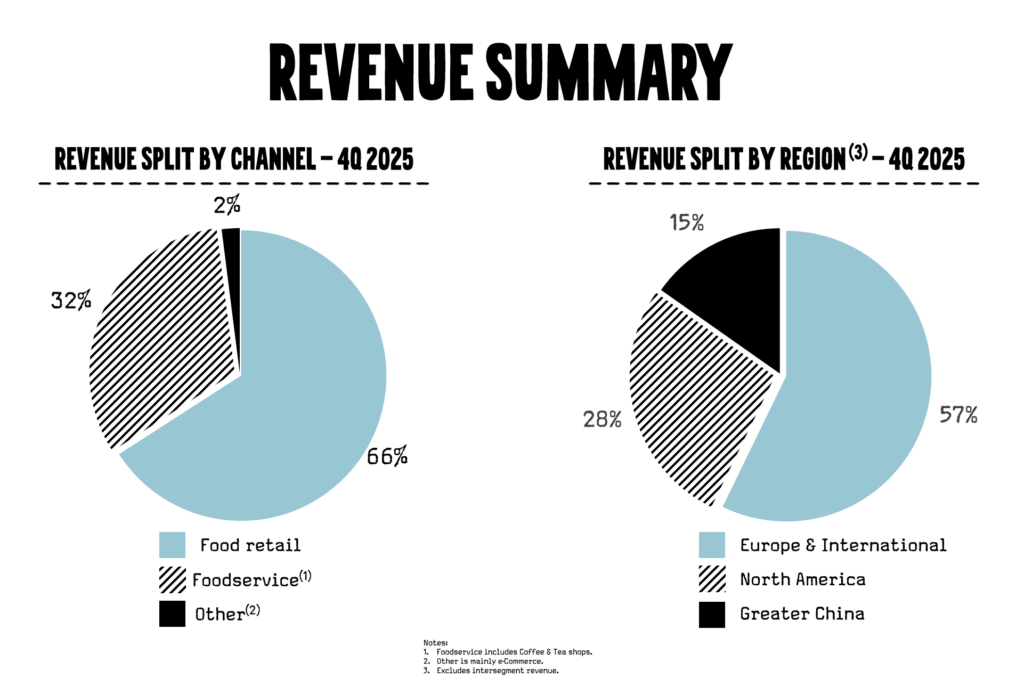
Its revenues in the Europe and International segment saw a 23.3% hike in the October-to-December period, and 79% of these sales came from the retail sector, driven by its barista lineup. This is Oatly’s largest market, accounting for 57% of its revenue in Q4 2025.
Retail dominates the firm’s North American footprint (making up 61% of its sales), where its revenue decreased by 8.8% in the last quarter of 2025. Its volumes contracted by 12.6%, primarily due to a “reduction in sales to the segment’s largest foodservice customer”. Excluding this, its Q4 sales here actually increased by 10%.
And in Greater China, where the company is conducting a strategic review after years of weak performance, Oatly’s 1.1% growth was primarily due to the foodservice channel, which contributes to 66% of its revenue here.
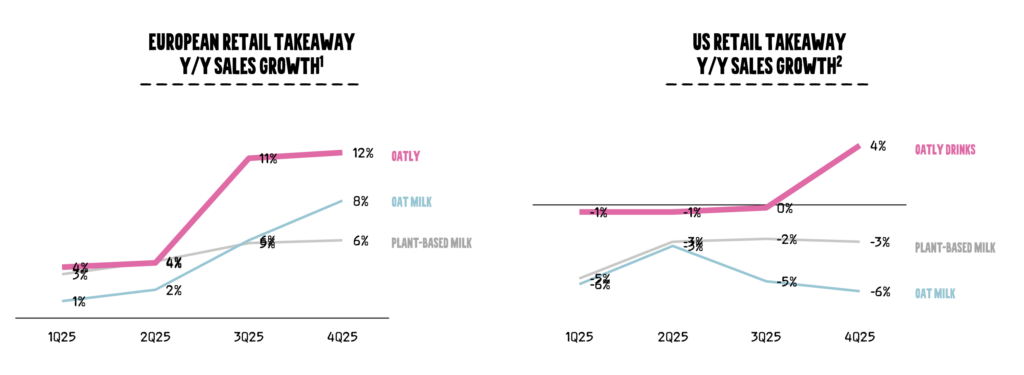
Its overal 2025 revenues were up by 11.2% in Europe and 13.1% in Greater China, offset by a 9.1% decrease in North America (though even here, the firm delivered 7% growth when excluding its largest foodservice customer). And when it came to retail, Oatly’s growth outpaced both the wider oat and plant-based milk segments in western markets.
Globally, its gross profit magnified by 17%, totalling $277M. And its net loss for the year reached $153.1M, a 24% drop from 2024.
Looking ahead, the company expects constant currency revenue growth between 3% and 5% for 2026, with adjusted EBITDA forecast to reach $25-30M. It will do so by doubling down on its growth playbook and, as Flatin put it, maintaining a “culture obsessed with efficiency and continuous improvement”.
“We remain focused on driving growth and impact in a disciplined and profitable way. Part of that disciplined building will be continued focus on improving our free cash flow, which has significantly improved each year but is not yet where we want it to be,” he said. “Our business plan remains fully funded, and bringing the company to structurally positive free cash flow is important to us.”
Oatly to launch barista oat milk for cold foam, but not protein
Flatin ascribed Oatly’s 2025 performance to new barista options – including flavoured versions and a format designed for automatic coffee machines – and products like the matcha latte. He nodded to the company’s taste-led strategy, which took a page out of the fashion industry playbook with seasonal recipe ‘lookbooks’ and a Future of Taste trend report.
“We’re focusing on our strength within beverages, as opposed to trying to mimic dairy in all its forms, from cheese to yoghurt, ice cream and on and on,” COO Daniel Ordonez told investors. He called Oatly “an alternative to dairy no more, but an experience canvas for the beverages market”.
“We are working with customers to renovate their menus and expand their shelves to be more relevant, more provocative and more on trend with today’s consumers. As we help customers become more relevant, we are gaining more space and visibility on menus and on shelves,” he added.
In 2026, Oatly is doubling down on product innovation. It announced new churros and coconut flavours for its barista lineup, a strawberry matcha latte, as well as an industry-first milk designed for cold foams.
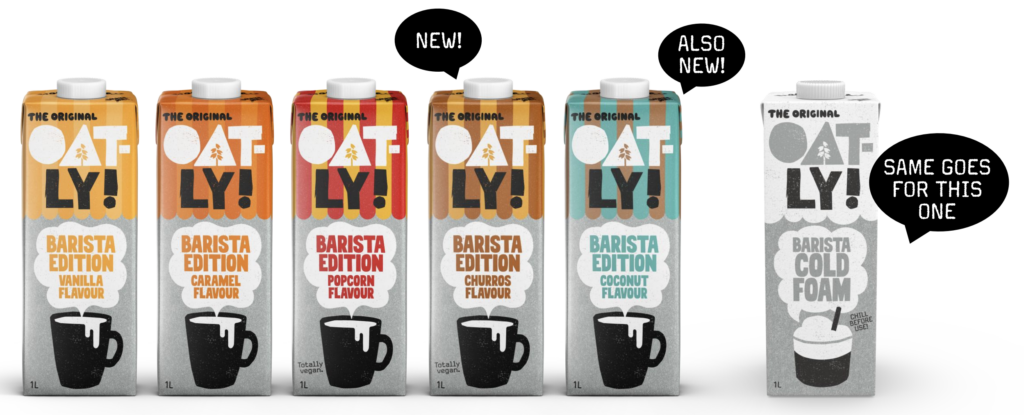
“I am particularly excited to announce the launch of our Cold Foam Barista that can be added on top of any beverage hot or cold, as plant-based cold foam options aren’t available in the market yet,” said Ordonez, hinting at a launch “very soon”. “This is a breakthrough product that will elevate the experience for our foodservice customers and will delight consumers.”
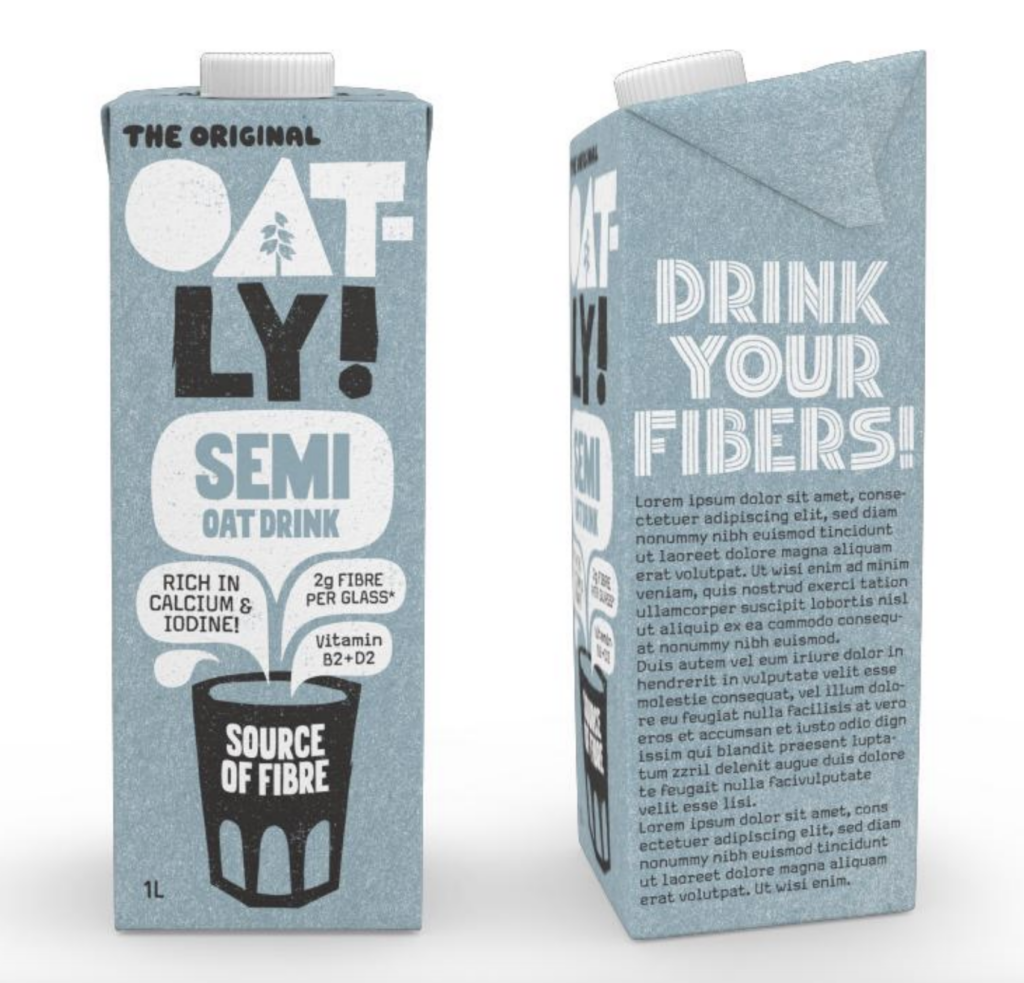
Last year, Oatly declared that fibre was “coming for protein’s crown”, and the brand has been capitalising on the fibermaxxing trend by highlighting its fibre credentials on-pack. But the reality is that protein isn’t going anywhere, and more people are looking for it this year.
Asked about plans for a protein-boosted oat milk, Ordonez said: “What science says is that the western world’s population has a fibre deficit of approximately 10g per day. And at the same time, there is a protein surplus… We’re very, very excited to see fibres and gut health racing in popularity, especially with Gen Z, and we will be very active in this space, not only advocating and campaigning for it.”
This aligns with what Bryan Carroll, UK general manager for Oatly, told Green Queen in November. “Most people already meet or, in some cases, even exceed their protein needs through a balanced diet,” he said. “This isn’t something in our plans. But we never say never in terms of product innovation.”
US dietary guidelines ‘concerning and a missed opportunity’
The news about Oatly’s profitability came the same day the UK Supreme Court dismissed its appeal against a decision that invalidated its “Post-Milk Generation” trademark. It reasoned that the term ‘milk’ can’t be used as a designator for oat-based products.
Oatly called the ruling anti-competitive and against the interests of the British public, arguing that it creates unnecessary confusion and solely benefits Big Dairy.
Asked how it affects the company’s current products, Carroll told Green Queen: “We are not currently using the slogan on our products or in advertising in the UK and haven’t for some time. We are in the process of ensuring the slogan is no longer being used on wider branded materials.”
In a LinkedIn post, he cited Nielsen data that showed the volume sales of conventional dairy drinks declined in the UK in the last year, in contrast to Oatly’s 2.9% growth.
Across the Atlantic, though, the MAHA-fuelled push for whole milk has brought dairy back into the spotlight at the expense of plant-based alternatives. And the new US dietary guidelines have further emphasised the role of dairy while putting the axe to processed foods.

Flatin suggested that cow’s milk volumes continue to decline, and they have been doing so for years. “Protein-enriched cow’s milk is the only one that is seeing an uptick. The rest is going down,” he said.
He praised the passage of the Whole Milk for Healthy Kids Act, which includes provisions to make it easier to access non-dairy milk in school meals. However, the dietary guidelines’ push for animal proteins and fats is both “concerning and a missed opportunity”, given how leading health experts have warned against encouraging an increase in meat and full-fat dairy and neglecting fibre.
“I still believe that dietary guidelines are a great starting point for national public health policy, and they can make an enormous difference in improving the well-being of citizens and farmers on the planet,” said Flatin, citing Denmark’s world-first action plan for plant-based food as the “best existing example out there”.
“The US market is very large, and it’s more complex. So the trends we observe in out-of-home, or [events like] Expo West in a couple of weeks, take time to appear on-shelf,” noted Flatin. “[The business is] expected to get progress, but only step by step… We’re very pleased that we see signs that we’re moving in the right direction.”