

Fewer Americans Consider Processing Levels Before Buying Food, Shows Survey

The share of Americans who factor a food’s processing levels into their purchasing decisions has declined this year, though uncertainty around the healthfulness of ultra-processed food continues.
The consumer and policy focus on ultra-processed foods (UPFs) in the US has intensified this year, ahead of the Food and Drug Administration’s (FDA) long-anticipated, now-delayed release of a definition for this category.
A new survey highlights the complicated nature of the debate surrounding these products. For many people, they’re public enemy number one when it comes to their diets. Others caution against conflating processing levels with nutrition, arguing that some UPFs can actually be good for you.
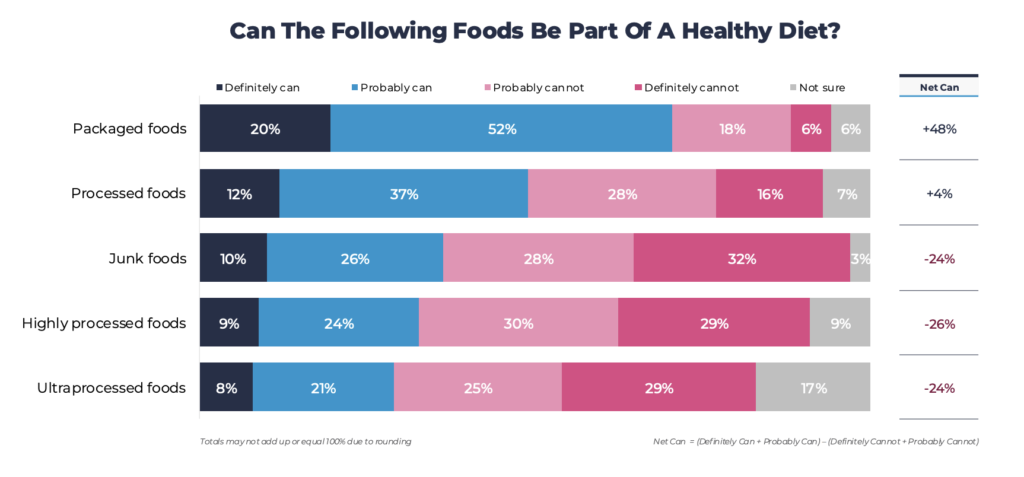
The International Food Information Council (IFIC) polled over 3,000 Americans this year and found that their attitudes around UPFs are evolving. Today, 73% of them take processing levels into account before deciding whether to buy a food. While that share is high, it’s a significant drop from the 80% who did so in 2025, indicating that experts’ calls for nuance are filtering through.
Americans think junk food is healthier than ultra-processed foods
Under the Nova classification that birthed the concept, food is grouped into four categories: unprocessed or minimally processed (like fresh produce), processed culinary ingredients (like olive oil and salt), processed foods (like certain cheeses and artisan breads), and UPFs.
The latter group is made up of foods made with industrial formulations and techniques or containing cosmetic additives thought to be of little culinary use. Put simply, they’re thought of as foods you can’t make in your home kitchen.
They were thrust into public consciousness by Chris van Tulleken’s 2023 book, Ultra-Processed People, and have faced policy attacks in the US at both state and federal level. Some studies have linked them to a host of health ailments, including early death.
However, other research has concluded that some UPFs (like whole-grain bread or fortified soy milk) don’t carry the same health risks as, say, a KitKat bar or a bottle of Coke, so bundling them all in the same category is misleading. For many, they’re just a fancy word for ‘junk food’.
Still, the Trump administration blamed “highly processed foods” for diet-related diseases in the new (and highly criticised) dietary guidelines, and is considering acting on a petition calling for the revocation of the GRAS status of certain UPFs.
Previous research shows that UPFs now top consumers’ list of health concerns – 72% of them are trying to avoid these products in their diets, and 79% feel they’re a “significant threat” to public health.
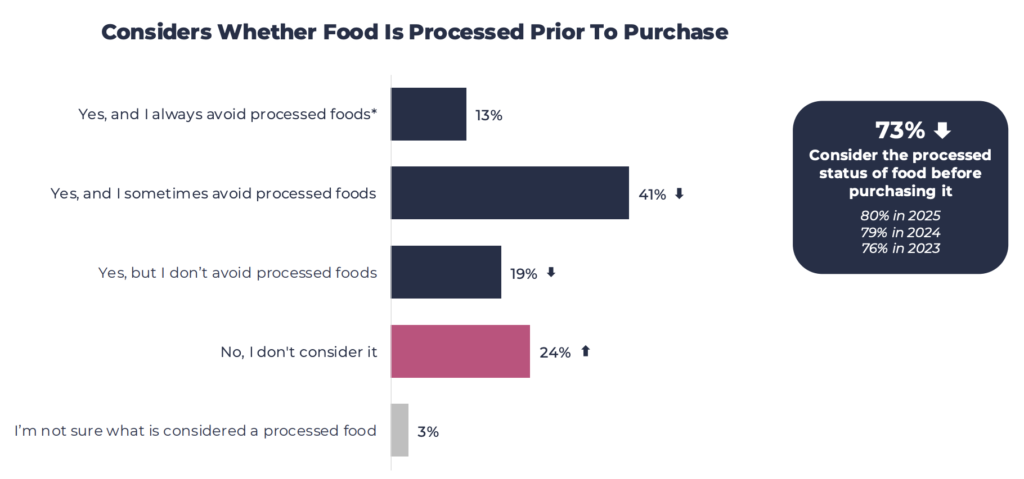
The IFIC poll suggests that more than half of Americans (52%) are now familiar with the term, up from 32% in 2024 and 44% in 2025. Asked if they can fit into a healthy diet, 54% believe they do not, whereas 29% think they can. The remaining 17% remain unsure, underscoring the lack of clarity around UPFs’ impact.
They’re slightly more receptive to “highly processed foods”, which 33% believe can be part of a healthy eating pattern. This rises to 36% for junk foods, and 49% for processed foods.
Eating more vegetables has had the greatest health impact
So how do Americans determine if a food is ultra-processed? Most look at the packaging, either at the ingredients list (56%) or the nutritional facts label (51%).
The IFIC survey highlights growing interest in using other resources, too. More consumers are now using AI assistants to identify UPFs (23%, up by five percentage points from 2025), relying on their own judgement (23%, up by 12 points), or asking friends or family members (11%, up by three points).
“These findings suggest that Americans are open to using a wide range of tools to evaluate processing level, blending existing label information with personal interpretation, social input, and emerging technologies,” IFIC said.
Processed foods may have been under attack in the dietary guidelines, but only 36% of Americans have made an effort to limit highly processed products in the last 12 months. More have tried to heed the advice to limit added sugars (44%), “eat real food” (49%), and consume fruits and vegetables (50%).
Consuming dairy has been the easiest recommendation to keep up with, as cited by 89% of respondents, followed by higher intakes of whole grains (80%) and fruits and vegetables (79%). Nearly three-quarters (74%) have found it easy to prioritise protein in every meal, too.
Meanwhile, one in five Americans (19%) say eating more produce had the greatest impact on their health, much higher than limiting processed products (9%). So it’s no surprise that a food’s freshness is the dominant way for them to describe a healthy food, a metric used by 40% of respondents.
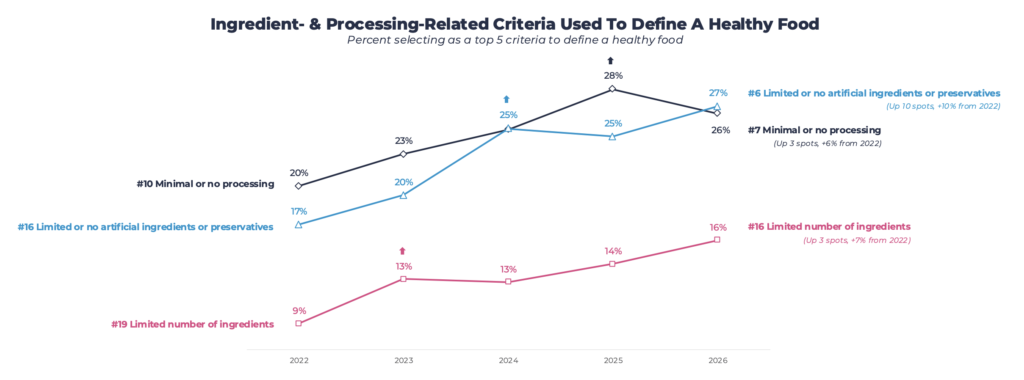
The share of consumers who identify minimal or no processing as a criterion for healthy food has dropped from 28% last year to 26% now, and the importance of limiting or eliminating artificial ingredients and ingredients has risen by two points (27%).
The research is the latest to outline the value of developing a standardised definition for processed foods, which the FDA has found “quite challenging”. US startup Wisecode has come up with its own version, classifying food as minimal, light, moderate, ultra, or super-ultra-processed – the latter two groups comprise products with many additives, industrial formulations, emulsifiers, and flavour enhancers.
“The rapid rise of ‘ultra-processed’ shows how far and wide terminology can travel in today’s dialogue,” said IFIC president & CEO Wendy Reinhardt Kapsak. “Still, familiarity with a term is not the same as a shared understanding of what it means or its application.
“As people blend label reading with personal judgment, social input, and even AI, the need for clear, credible, science-based guidance has never been greater.”