

Nestlé, the World’s Largest Food Company, Adopts Climate-Friendly Cocoa-Free Chocolate

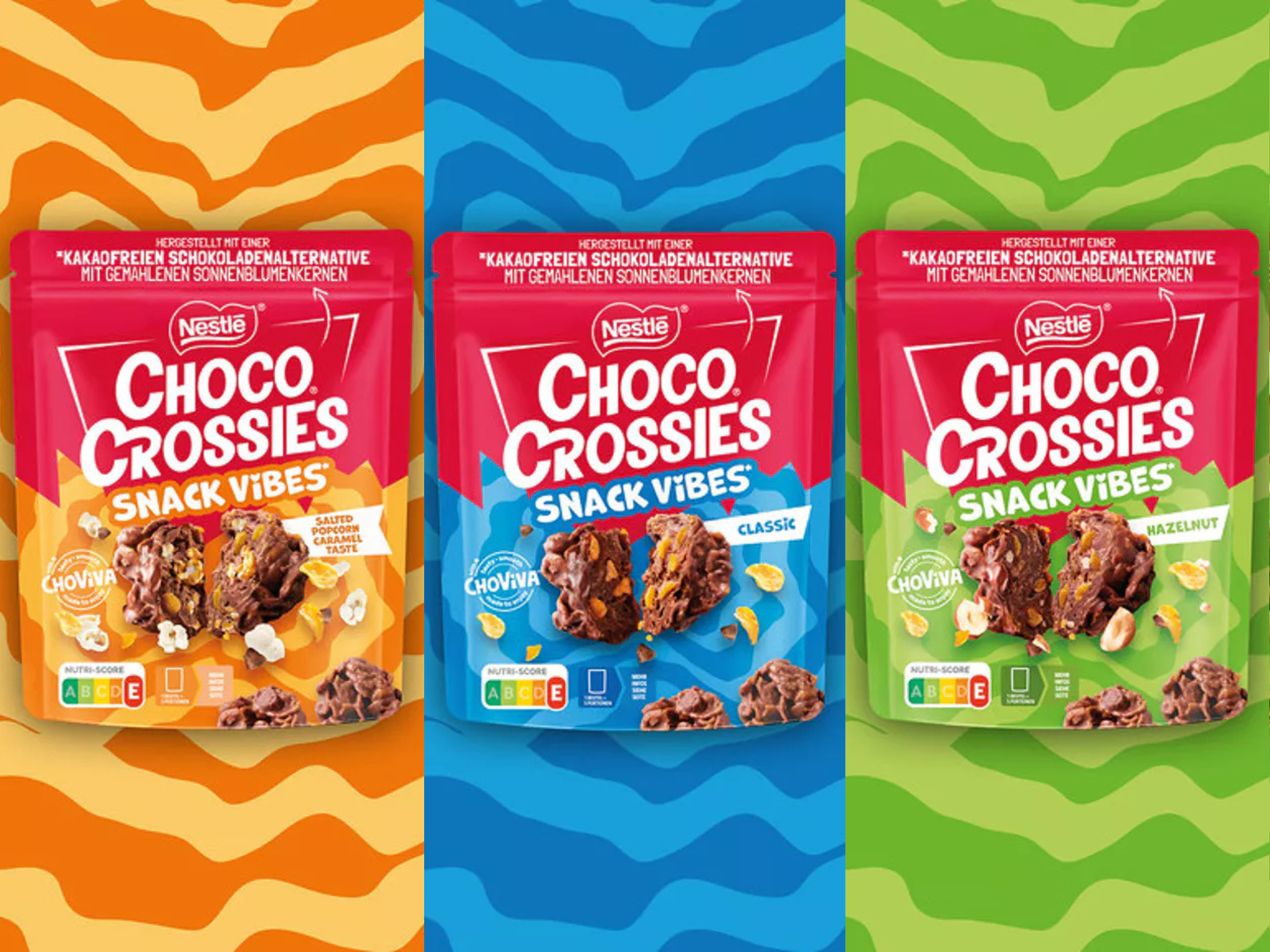
Nestlé has launched a new Snack Vibes line under its Choco Crossies brand with ChoViva, a cocoa-free chocolate alternative by German food tech startup Planet A Foods.
If there were ever any uncertainty about the potential of chocolate alternatives, the world’s biggest food company has squarely put it to rest.
Nestlé has teamed up with Planet A Foods, a startup making cocoa-free chocolate from fermented plant-based ingredients, to introduce a new Gen Z-targeting confectionery range in Germany.
Snack Vibes, marketed under the Choco Crossies brand, will be available in classic, hazelnut and salted popcorn caramel flavours next month. Priced at €2.79 for a 100g pack, each innovation is made from Planet A Foods’s ChoViva ingredient instead of conventional chocolate.
It’s a sign of the times, with the cocoa industry struggling to meet demand amid falling yields and rising prices in the face of climate change.
“The cooperation with Nestlé fosters ChoViva’s role as a strategic partner for brand manufacturers,” says Maximilian Marquart, co-founder and CEO of Planet A Foods. “We support brands to directly engage with younger generations and build lasting relevance with the consumers of tomorrow.”
Nestlé launch builds on Barry Callebaut partnership for ChoViva

To make ChoViva, Planet A Foods puts a base of sunflower and grape seeds through proprietary fermentation and roasting processes to elicit aromas, flavours and textures similar to cocoa. These are then combined with plant-based fats and sugar to create a mass that can be used as a 1:1 replacement of chocolate.
The ingredient is available in vegan, dark, milk and white chocolate formats, and has featured in over 120 products across 10 countries in Europe and Asia, with partners such as Lindt, Aeon, Lufthansa, Deutsche Bahn, Kaufland, Rewe, Aldi, and Lidl.
Having raised $30M in late 2024, Planet A Foods has successfully expanded the capacity of its production facility in Pilsen, Czech Republic, from 2,000 tonnes to over 15,000 tonnes annually.
To ensure the continued availability of ChoViva, which can be found in more than 100,000 stores globally, Planet A Foods relies on a commercial partnership with Barry Callebaut, the world’s largest chocolate supplier.
The Swiss company already supplies to industry giants like Unilever, Hershey’s, Mondelēz International, Mars, and yes, Nestlé. If you’ve ever had a KitKat bar, you’ve likely eaten Barry Callebaut’s chocolate.
Its collaboration with Planet A Foods provides manufacturers with a reliable option to navigate the volatility of the global chocolate market and the heightened supply chain requirements.
You only need to look at the iconic Reese’s brand, which has been the subject of intense scrutiny for swapping milk chocolate for compound coatings on several products. The change has no doubt been spurred on by climate change, which has led to unsustainable price hikes for cocoa. It’s why Hershey’s, Reese’s parent company, was forced to raise prices by double digits and cut its annual forecast last year.
“The question the Reese’s backlash really asks isn’t: ‘Why did Hershey change the recipe?’ It’s whether the food system can move fast enough to give companies better choices before the next ingredient fails – and the next, and the one after that,” Chiara Cecchini, VP of commercialisation at Savor – which makes sustainable fats from carbon – wrote in an op-ed for Food Dive this week.
Nestlé tackles sales and climate issues with cocoa-free chocolate

Nestlé’s embrace of ChoViva is the latest marker of Big Chocolate’s need for cocoa-free solutions, which are becoming more vital by the day.
Climate change pushed cocoa stocks to their lowest levels in a decade in 2024, when its prices broke all-time records. The two largest producers of cocoa – the Ivory Coast and Ghana – have lost over 85% of their forest cover since 1960, and scientists have warned that a third of the world’s cocoa trees could die out by 2050, leading to a global shortage.
One of the food-related drivers of the climate crisis is chocolate itself, which emits more greenhouse gases than any other food except beef, and is linked to widespread tropical deforestation. It’s also a water-guzzling industry: a single bar of chocolate requires 1,700 litres of water on average.
In contrast, Planet A Foods’s ChoViva lowers emissions by 82-91%, depending on the type of chocolate. This is crucial for Nestlé, which captures nearly 10% of the global confectionery market and is the industry’s biggest polluter.
The KitKat maker posted a 2% drop in its annual sales in 2025, citing complex trading conditions for key ingredients like cocoa, which traded at notably higher prices last year. To tackle this, it has developed a novel method to utilise 30% more of the cocoa plant to increase yields.
It is one of a number of chocolate industry giants to have embraced climate-friendly alternatives. Lindt, Cargill, Dulciar, Walcom, Piasten and have already co-launched bean-free formats, in a space that includes innovators like Voyage Foods, Prefer, Win-Win, Foreverland, Nukoko, and Endless Food Co.
Meanwhile, Mondelēz International, Cargill, and Puratos are developing cell-based cocoa solutions with Celleste Bio, Kokomodo, and California Cultured, respectively. It’s a space Lindt and Barry Callebaut have also invested in.
“Commitment to alt-cocoa has been growing over the past few years, though it needs to fit alongside their other categories and complement traditional cocoa solutions and should not go against it,” Marquart told Green Queen in an interview earlier this year.